Sunday, June 10, 2012

Differential Rates of Currency Decay Explain Europe's Unsolvable Dilemma

10 June 2012

Quick comment.

Since the nations of the world, led by the example of the United States, aboandoned the gold standard, all of them have allowed their currencies to decay at a steady clip. We call it "inflation," perhaps a euphemism. My suggestion, we should call currency destruction what is is, "currency decay."

If you understand this concept, you will understand the present problem with Europe.

In brief, the Deutsch Mark, if it stil existed, would rise relative to other currencies, as German monetary policy is less inflationary than that of most other major nations. Note - it is still inflationary, just less so relative to the policies of its peers.

In brief, this is why the European Monetary Union is failing. Greece has always permitted a rapidly decaying currency, as Greek citizens have a habit of taking long holidays, retiring at 60, not paying income and property taxes, and not even paying for government-provided services, including electricity. Similarly, Spain, Portugal and even Italy are "relaxed" when compared to the more industrious French and German economies.

So what we are seeing now is currency decay to the point of outright "rot" in Greece, and quickening currency decline in Spain (with Portugal, Italy, Ireland and certainly others "following along").

How does one maintain monetary union in such a case?

In brief, it can't be done.

The nations with slowly decaying currencies must continuously bail out those that tolerate more rapid decay and outright decomposition, with Greece being the current poster child.

It's not fixable.

(Thanks to Hookedblog for today's images.)
_

Thursday, June 07, 2012

What Is Wrong.... A One-Paragraph Summary

7 June 2012

This is a paragraph that I wrote to a liberal friend today (slightly expanded from the original):

I am not a conservative, but I also differ with many liberals, so I'm not sure what category I fall in. I believe in free markets, but our present market is manipulated. Our corporate "titans" seem to manage businesses for themselves, not for their shareholders. General Electric Corporation, as an example, has shed 58% of its value since the year 2000, and the broad markets have punished shareholders for 12 years. The ultra-rich are taking everything private, and closing out public participation in ownership of assets. Governments are adding gatekeepers and regulators, and shedding service providers, builders and maintenance workers. The income tax code is a Byzantine labyrinth that favours the rich and punishes the middle class. We are conducting costly wars on drugs, privacy and terror. Paul Krugman is calling for more debt, which cannot possibly work long-term (look at Japan for a trip down that road). Unions are losing the battle to protect their members, but winning the battle to prevent young people from entering the workplace. I hope you grasp my dilemma. It seems that everyone on both the left and the right is doing exactly the wrong thing. My personal investment strategy (precious metals) is predicated on the assumption that decision-makers everywhere, given a choice, will take action without consideration of long-term consequences. Our governments are accumulating debts that the young cannot pay, and the prospect is that we shall all be taxed at ever greater levels in order to fund the ballooning cost of a world that none of us wants. There are of course bright spots out there, but the broad trend is as negative as I have ever seen.
_

Thursday, May 31, 2012

The Market is an Instinctual Beast

31 May 2012

I've been thinking about the behaviour of markets lately. While there is a theory of "rational markets," I don't think it can be defended.

Better Mr. Keynes' trenchant observation, "Markets can remain irrational a lot longer than you and I can remain solvent!"

Indeed.

Rather, I argue that markets are instinctual beasts.

Having had years of experience horseback riding in the Canadian Rockies, I can attest that the horse is a very instinctual animal. It is also unstoppable when under the immediate influence of instincts such as "fight or flight," "startle," or "running with the herd." As the average horse weighs a half ton, basically, you don't stand in the way of an instinctual beast that is many times your own weight.

So too, we should not stand in the way of the market when its instincts are triggered. You have to "go with" the market, though obviously we can "steer" by choosing where we place our investments!

Another image of the market as an instinctual animal references the seasonal instincts of the birds. Right now, the robins are building their nests. As I have about 300 trees surrounding my home, I'm seeing lots of robin activity, right now. A naive investor might therefore conclude that the best place to invest is in nest-building materials.

However, as the seasons change, the instinctual behaviour of the robins will alter as well. Based on my own experience, after nest-building comes the territorial defense of the anticipated, and then the newly-hatched young.

And of course, the seasons change again, as they do in their cycles, and soon enough, all of the seasonal brids will leave, flying south. Those invested in nest-building materials will experience a "bear market."

Then it shall be widely assumed by the market that, as robins no longer live here, robins simply aren't a good investment. Until, of course, they return the following spring. The instinctual beast does not think that far ahead!

And so it goes with the markets.

Bill Fleckenstein observed this week, "the market is playing checkers, not chess." It thinks ahead, but only in somewhat obvious ways.

My present take is that the markets have been in a so-called "risk off" mode since 1999-2000, which involves moving out of equities and into government and other bond instruments. (In fact, the original move to bonds occurred with the ascent of Paul Volcker at the Federal Reserve, as, due to his influence, the prime rate peaked at 21.5% in December 1980, though that is another story.)

Now it is no secret that inflationary monetary policy relies on low interest rates to enable the jugglers to keep all their bowling pins in the air.

Of course, when inflation is in vogue, debts accumulate, and ultimately, this undermines the foundation of the bond market, as investors grow concerned about inflation eating away at their investment (as governments rely on monetary inflation to make debt repayment "affordable").

Bond buyers then demand higher interest rates as a "risk premium." This is what's happening in Greece, Spain and Italy right now. But countries with printing presses are accorded continuing low rates, as we are all willing to pretend - for a season - that inflation is not real.

Now it is my prediction that the seasons of the market will change yet again - it would hardly be surprising to anyone with a historical view. I suggest further that with the next seasonal transition, the markets' instunctual responses will also shift - and dramatically so!

When the robins have flown south, bonds will be viewed as vulnerable to devaluation by inflation (it's already happening, as I've written many times, but we simply pretend it's not).

The "risk off" instinct towards bonds has prevailed for 12 years, with a seemingly solid 20-year foundation unde
lying the recent era of the dominance of bonds. But this season, too, shall change, as all seasons do.

Now, when the instintual behaviour of the market next shifts, what should we expect?. In my view, bonds will become the next "risky" asset, and investors will begin to flee them in droves, with bonds emerging as "the next bear market." Today's ultra-low, even record-low bond interest rates will prove unsustainable, just as did investing in the nest-building business.

So if "risk off" is the current instinct of the market, driven by the buying of the bonds of governments that print their own money, what then shall be the next instinctive market trend?

Well, bonds will remain in a bear market, probably for a very lenghty period. The stock market, already dead in the water for 12 years, is not set to recover any time soon.

My prediction is that the next season will be that of the treasure hunter - dominated by those seeking "security" through a search for value. The new treasure seekers will dig much more deeply than today's "risk off" traders, who have little more than herd instinct to guide them.


Where have treasure hunters always looked? You know and I know that the object of the treasure hunter is gold, and this is where the instinctive behaviour of the market will turn next.

So, my advice is to find your treasure now, by holding your savings in precious metals and in the stocks of companies that mine or derive royalties from precious metal production.

I wish successful treaure hunting to you all!
_

Tuesday, May 15, 2012

Our Safety Net: HUI:GOLD .204; HUI 275-300; Gold $1360 or so...

15 May 2012

I posted this letter to my friends today, and it's intended for readers with some technical knowledge of the gold and gold mining markets:

The HUI is not going to retest its 2008 lows, but the HUI:GOLD ratio is. Looks like we're gaming for a double (or triple, if you prefer) bottom on this chart, meaning the HUI:GOLD ratio probably falls to the 2000/2008 lows (.204). We're now at .243, so that's actually only four decimal points to go. No big deal (ha!).

Assuming gold swoons to $1400 or so, or stays higher, that means the low for the HUI would be 275-300, vs its low of 150 in 2008.

With the HUI at 375 today, gold at $1545, etc., I'd say the numbers stated above are the visible bottom. That is much lower than I expected, but the HUI and gold would both double their 2008 lows, which sounds a bit fractal to me.

My call: HUI:GOLD .204; HUI 275-300, Gold $1400 or so ($1360 is double the 2008 low). I'm not happy about this, but it's twice the Oct 2008 level.

On a positive note, so long as we're thinking it's a fractal double (remember, the sellers will be extinct), then the upside target for the HUI is an optimistic 1275, so who's complaining? As they say on the street, we're closer to the bottom than the top, and we're certainly finding the bottom in a hurry! I'd be a buyer at HUI 300, and there's probably no rush to take action before then!

I also expect gold to lead on the way back up while the broad market continues to fall, as we're getting some kind of revisit of 2008 for some reason....(More thoughts later, maybe???)

Here is the HUI:GOLD chart:

Hold on everybody. It will be steep and hard, but relatively brief at this juncture!

NOTE: Dan Norcini has thoughts similar to my own. Click here for Dan's thoughts on the current rout (a consequence of the parabolic September 2011 blowoff in the gold price, by the way).

17 May 2012: Possibly the levels I have identified here are our safety net. That is, if we don't fall off the tightrope, we may not have to fall this far! At this point, I'm not sure. The good news is that there IS a safety net in place, making us secure for the time being!

24 May 2012: Hmmm. More bottoming signs are in. If we're basing and starting a new uptrend, take my word for it, we shall soon be seeing the mother of all bull runs in the gold and silver markets!
_
Link

Monday, May 14, 2012

Krugman Creates a Stir about Greek Euro Exit

14 May 2012

This is interesting. As readers of my blog will be aware, I have many differences with Paul Krugman as to economic theory and practice. In particular, I am in opposition to his view that rescuing the badly behaved is wise economic policy.

However, Mr. Krugman's recent comments on the imminent necessity of Greece's leaving the Euro as a shared common currency are of importance.

I'll focus on these two points in Mr. Krugman's brief post:

1. Greek euro exit, very possibly next month.

2. Huge withdrawals from Spanish and Italian banks, as depositors try to move their money to Germany.

Many economists are concerned about the possible implications of a Greek withdrawal from the Euro, now considered probable, based on the dramatic "anti-austerity" results of the recent Greek election.

I for one am paying attention to Mr. Krugman this time.

Watch Spain and Italy... now!
_

Saturday, April 14, 2012

My Simple Prescription for US Bureaucratic Bloat - in One Paragraph!

14 April 2012

As I'm busy these days, I've been posting links to great articles, and adding my comments.

Paul Kasriel has just published a very simple economic graph:

The US federal deficit remains high because tax receipts are down and expenditures are static (that is, little growth, but little corresponding structural reform).

My proposed fix is this simple:

(1) Trim the bureaucracies that determine who pays and who receives federal funds (they are massive and grow like Topsy).

(2) Simplify receipts with a flat tax (goodbye IRS, you can let 90% or more of the staff and all of the exemptions go).

(3) Simplify expenditures with simple universal social/health programs and with good quality infrastructure initiatives with almost no bureaucrats - healthcare for all, support for the participation (and employment) of citizens with disabilities, good highways & bridges, marketable multiple sources of energy (from conventional to biodiesel to space-based solar to acoustic fusion), accessible high quality education and (yes) expanded fundamental scientific research, including molecular biology, robotics and space exploration (a big "boo" to Mitt Romney on that one)....


(4) Retrain the bureaucrats with productive skills, starting with growing gardens and flipping veggie burgers!

That's it. All better.
_

Tuesday, March 20, 2012

Mr. Bernanke Scores Zero on His Term Paper, As Marked by Me

20 March 2012

To my knowledge, Mr. Bernanke has never done this before. He has laid out his delusional belief system for all to see. (Ben Bernanke, a former Princeton University professor, is the Chairman of the US Federal Reserve, a private corporation which manages money supply and interest rates in the US.)

Indeed, the emperor has no clothes.

Joe Weisenthal, an intrepid reporter with Business Insider who has a notable nose for news, summarized Mr. Bernanke's first lecture on the history of the Federal Reserve as follows. Note that Mr. Bernanke began by attacking the gold standard. That was mistake number one. Mr. Bernanke's multitudinous errors proceed from there....

In my family archives, I still have an essay written by my father on the gold standard from his college days in the late 1930s. Let me tell you, my father got it right over 70 years ago, and Mr. Bernanke has gotten it 100% wrong today. Would that my father had chaired the Federal Reserve instead of Mr. Bernanke (and before him, Mr. Greenspan).

Mr. Wiesenthal, who is indefatigable, summarized Mr. Bernanke's speech as follows:
  1. To have a gold standard, you have to go dig up gold in South Africa and put it in a basement in New York. It's nonsensical.
  2. The gold standard ends up linking everyone's currencies, causing policy in one country to transmit to another country (sort of how U.S. policy now transmits to China, because they've fixed the yuan price to the dollar). So for example, if the U.K. fixes the number of pounds to an ounce of gold, and the U.S. fixes the number of dollars to an ounce of gold, then the pound and the U.S. dollar inadvertently become linked.
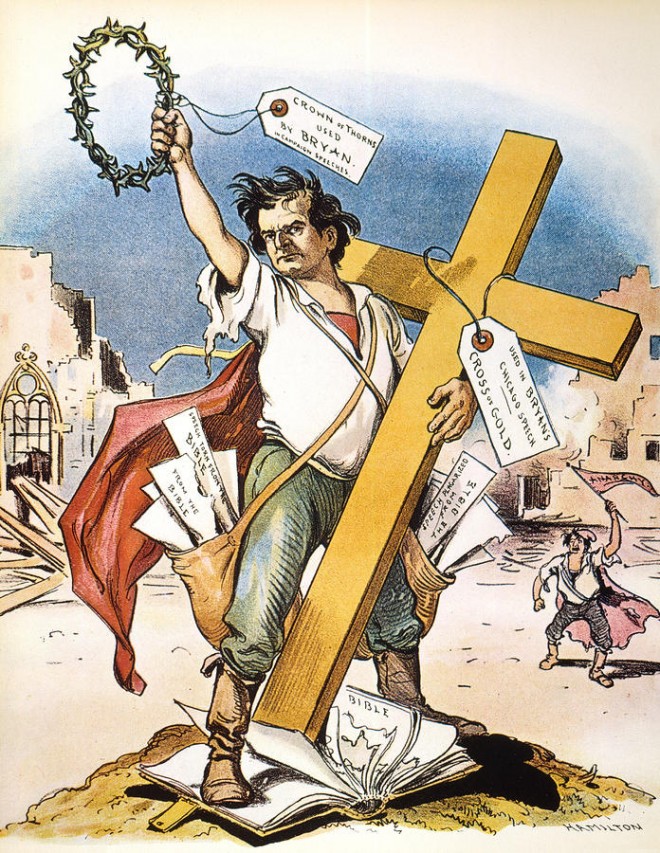
  3. It creates deflation, as William Jennings Bryan noted. The meaning of the "cross of gold" speech: Because farmers had debts fixed in gold, loss of pricing power in commodities killed them.
  4. The gold standard tends to cause interest rates to rise during downturns and interest rates to fall during good times, the exact opposite of what monetary policy should be doing.
  5. The economy was far more volatile under the gold standard (all the depressions and recessions back in the pre-Fed days).
  6. The only way the gold standard works is if people are convinced that the central bank ONLY cares about maintaining the gold standard. The moment there's a hint of another priority (like falling unemployment) it all falls apart.
  7. Gold standards leave central banks open to speculative runs, since they usually don't hold all the gold.
Sadly but truly, the above summary is more or less what Mr. Bernanke had to say in his first of four lectures. From here, we can't expect much success in the subsequent lectures. How do you make a building stand when the foundation is unstable - perhaps not even there?

I replied to Mr. Weisenthal's summary as follows:

"Just to summarize, Bernanke is wrong on every point. However, this is the clearest exposition yet of his twisted logic. Others will refute this completely, so permit me to highlight a couple of the more subtle points:

1. We lock gold away because it is a real and rare substance that has real value (humans want it for many reasons, creating demand).

2. The interlinking prevents one trading partner from cheating another with bad money (as the US has done to China).

3. Deflation is the desired outcome of increasing productivity.

4. Savings are rewarded during downturns, creating income stability for the prudent, as well as future capital for business investment (also by the prudent).

5. The point about volatility is true. However, that kind of volatility (A) teaches everyone to be cautious vs reckless, and (B) prevents black swans, which emerge when volatility is suppressed by central banks while the underlying system rots.

6. It is not the job of any central bank or government to target employment. Free markets do that all my themselves.

7. Let's look at the run on the US gold hoard in the early 70s. Oh yeah, the US was running a guns and butter policy and undermining its currency. The French figured that out and took their gold. So governments that manage their budgets foolishly get punished by the free market. Hmmm. That is bad? Why was that again?


"To be clear, von Mises dealt with all of Bernanke's points half a century ago. However, knowing that Mr. Bernanke thinks this way helps me sleep more soundly at night as a gold investor. It's amazing how the smartest people can rationalize the most egregious behaviours.

"Mr. Bernanke, that will be a big round 'zero' on your term paper. Please go back to kindergarten and start over"

Read more at the Business Insider (and weep for the lost financial guardians of the US financial system).

As Mr. Bernanke pointed out, prices were unstable in the short-term under the gold standard (but stable over the long-term). How exactly has the Federal Reserve fixed that problem? See the chart below.

Since the creation of the Federal Reserve in 1913, prices are now unstable over both the short-term AND the long-term. Gee, thanks for fixing that problem, Mr. Bernanke!

Also check out this more recent article on Business Insider.

More from von Mises on the gold standard here.

30 March 2012: This is true. Paul Samuelson, the author of the world's best-selling economics textbook, "flunked" Mr. Bernanke shortly before his death in 2009. Click here.
_

Saturday, March 10, 2012

US Debt to GDP: Think 160% (Higher than Greece, Spain, Italy & Portugal)

10 March 2012

Bruce Krasting, a retired hedge fund manager, has recently taken a look at the off-balance sheet debt of the US government.

When you add the off-balance sheet debt (much of it high-risk loans to the public) to the $10.4 trillion in official government debt held by the public, you get a $24 trillion figure, in contrast to an annual GDP figure of $15 trillion. (That is, the above chart overlooks this $13-14 trillion off-balance sheet amount.)

This gross debt to GDP figure is actually the highest in the developed world.

Think Enron.

So exactly why are US government bonds considered a safe haven? You've got me.

My take, not that far down the road, the safe haven status of the US will be challenged by the international community. Whoever happens to be president at that juncture may have an unfortunate time with the history books.... (Not a job I would want, nor recommend!)
_

Wednesday, February 08, 2012

Late Night Thoughts on Gold Scarcity - Nearer Than You Might Think

8 February 2012Link
Back in 2003, I read every article on gold and gold investing I could find. Now I only read those that I think will introduce me to truly new ideas, or that are composed by authors whom I regard as considerably wiser than their peers.

Jeff Clark, a partner of Doug Casey, is one of the writers whom I trust to make me stretch my thinking a little bit further. Jeff has again succeeded, in his new article, "A New Reason Gold Stocks Will Soar."

Anyone who is economically minded thinks in terms of market rule #1: Prices are set by the balance of supply and demand. Here's what we don't often think about. Human population is rising more rapidly than the rate of gold production, while at the same time, most nations in the world are engaged in a process of "competitive currency devaluation."

Human population has increased 15% since 2000, while annual new gold supply has fallen 4.2%. The rate of printing of new money by most world powers has been running 5-10% per year since 2000, and the US has increased its (more rapidly devaluing) money supply at this torrid pace since 1960.

Let me walk you through a scenario that is not that difficult to imagine.

1. Let's say that at some point, a market shock pushes up treasury yields (effective interest rates) for the major powers (the US, Britain and the European Nations, Japan, and perhaps China). The Europeans have already shown us that even at rates in the 7% range, countries such as Italy and Spain are unlikely to be able to repay their debts (interest rates on debt will grow more rapidly than government revenues). At 7% interest, the US would be paying $1 trillion per year to service its world record-setting debt load.

2. As Mr. Clark points out, the market capitalizations of Apple Computer and Exxon Mobil are each larger than the combined valuations of every gold mining company in the world. China alone (mostly its private citizens) bought slightly over half of all of the world's new gold supply (3.3 million ounces) in the month of November 2011. And the $47 billion of gold investments held by global pension funds represents only 0.15% of their total holdings (an amount almost too small to be detectable). If that infinitesimal number were doubled, gold and gold stocks would still represent only 0.3% of institutional investments. That is, a doubling of institutional gold investments would still leave pension funds holding an amount of gold investments too small to mention or think about, but it would add $47 billion of demand to the (tiny) global gold market.

3. Mr. Clark is thus presenting a different kind of supply and demand argument. Consider only two factors. A doubling of Chinese demand (it's possible, the Chinese are massive savers) OR (not AND) a doubling of institutional demand (bringing institutional gold-related assets from 0.15% to 0.3% of total holdings) would effectively remove ALL new gold supply from the markets.

What would this mean for the average investor?

Think about it. We're not talking about rising prices in the face of increased demand. We're talking about NO SUPPLY in response to only marginally increased demand. Gold bullion, gold coins, gold certificates. It doesn't matter. Physical gold would rapidly become unavailable to the ordinary saver/investor AT ANY PRICE.

At this point, you might be asking, "Gold is mostly held in storage. It has only minor industrial and economic uses. Who would care?"

Here's the problem with the "who cares" argument. As we discussed earlier, even a minor spike in interest rates (say to 7%) would create a financial crisis in almost every major national economy. That is, our government leaders would have to pare back government services to a drastic degree (unlikely to be popular: consider the present situation in Greece being replicated in every major nation in the world), or to pay their mounting debts by inflating and devaluing their currencies (a step that they have already taken). At some point, currency devaluation causes citizens - particularly savers - to lose confidence in the currency itself, and thus to seek alternative stores of value.

Now you'll understand why gold has been the world's "reserve currency" for thousands of years. Imagine holding your wealth in barrels of oil in your back yard. it poses storage problems. Gold is the most effective and time-honoured store of value, particularly during a period of loss of confidence in "printed money." That is, when there is a growing sense that "nothing" has or holds value, then the demand for reliable stores of value increases. And as we've established, a massive surge in gold demand would not be needed to unbalance the market. In fact, a minor and incremental increase in gold buying is all that it would take to "clear the market," leaving no more gold available at all for sale to the average consumer.

In conclusion, I'm not asking you to imagine a world where gold is "expensive," perhaps much more so than today. I'm asking you to imagine a world in which gold is simply NO LONGER AVAILABLE to the average citizen saver at any price.

Read Jeff Clark's article here for more details and analysis.
_

Saturday, January 28, 2012

Project Moonbase - Mr. Romney Opts Out (To Our Peril)

28 January 2012

Mitt Romney just wrote himself off in my book. He opposes Mr. Gingrich's plan for a moon base, and would "fire" any staffer who suggested such an idea. (Click here.)

Has anybody here thought more than 50 years ahead? By 2062, we will certainly not have enough oil or natural gas to power human activity. The US and China have extensive coal reserves, but that is hardly appealing as a long-term energy plan.

Even with voluntary, or even mandatory, population control, we will still have 7 billion, and almost certainly more, humans inhabiting the planet.

Hopefully some plan for nuclear fusion as a source of power works out, but what if it doesn't? (It's not going to be easy to re-create the interior of the sun on our planet, even in "micro-spaces.")

We know for sure that the best source of solar energy is in space. If we're not operating in that environment in 50 years' time, we risk catastrophic developments. I'm just saying that humans (and by then, our robotic extensions) will have to be very active in space.

If Mr. Romney has never even thought about this, he is not fit for the presidency in my view.

_