16 April, 10 May & 10 June 2010 Read carefully. The title of this piece is NOT "Reaganomics," but "Renegonomics."I came across this interesting snippet from Bill Fleckenstein today, who refers to "the hidden benefits of debt repudiation and forbearance by the banking system, all of which have been created by the government's easy money and bank bailouts."What are we talking about here?Again, to quote Mr. Fleckenstein (literally no one could say it better): "People who aren't making home payments; or those who are participating in short sales on homes they can actually afford -- in other words, the folks who in essence reneged on mortgages that were under water and did so because they could -- have extra money to spend that they wouldn't have if they'd been making payments."How much money are we talking about?
 According to Mr. Fleckenstein, "I've seen recent estimates as high as $2 trillion being available, which is a lot of extra juice for the economy, especially with that extra juice hitting the skinnied-down state that the world came to in the wake of the (2008) financial crisis."What was that again?The US economy is booming because people who don't pay their mortgages have experienced a windfall.... In essence, rather than paying their mortgages, these underwater homeowners are directing their extra cash on hand into the marketplace, providing an unlikely boost to the consumer economy!Those who renege on their mortgage payments - with the full blessings of the state - have a lot of free cash on their hands - as much as $2 trillion in unpaid mortgages - and it is feeding the US economy (while US government bail-out programs soak up the damage to the lenders who aren't getting paid by the deadbeat mortgage holders).
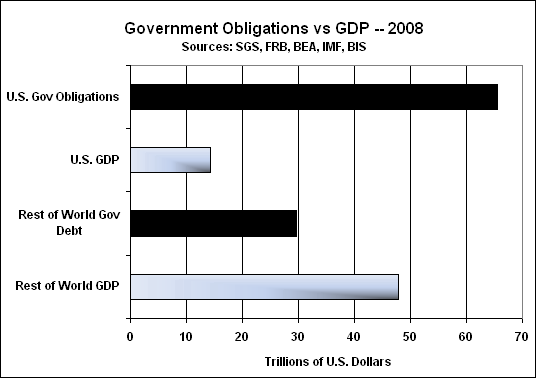
 Mr. Fleckenstein explains it as follows: "Think about the entire U.S. economy as, in essence, a company. While the balance sheet has become astronomically worse -- in the form of current (though postponed) debts, as well as future obligations -- the income statement has been boosted recently: Those folks who are upside-down in real estate have been given a reprieve, and the real-estate market itself has been given a shot in the arm by tax credits (think: extend and pretend). So, the income statement for now looks okay, as does the economy. In sum, company USA is 'worth' a lot less than it used to be, but for the moment its operations are okay, at least on the surface."
 So, you may ask, what's the problem? Sounds pretty good. The folks underwater on their mortgages are powering the economy, and the US government is rescuing the unpaid lenders. Should we not applaud the mortgage non-payers (and the US government that is enabling them) as the source of our current salvation?According to Mr. Fleckenstein, here is the conundrum: "The prudent have been asked to bail out the reckless -- and it won't work over time. The 'do-over' that the world was given during the financial crisis, courtesy of the printing press (read: government bailouts), will be 'paid for' with higher inflation and ultimately higher interest rates. But that's getting ahead of ourselves. The only people more upset than those handful of prudent types are liable to be the deflationists, who haven't yet realized that their best chance of victory has come and gone, at least until the printing press is taken away."
 That is, we are setting ourselves up for runaway inflation. So far, the collapse of the real estate bubble has masked the rampant inflation brewing beneath the surface (check out the annual increases in the cost of a can of beans at Wal-Mart over the past 5 years if you doubt me).2005 - 52 cents2006 - 58 cents2007 - 62 cents2008 - 68 cents2009 - 78 cents2010 - 82 centsPamela and Mary Ann Aden report that the yield on the 30-year US government treasury bond has now broken out to the upside for the first time in 29 years. This signals big-time inflation and long-time inflation - perhaps decades of gradually escalating, increasingly pervasive, and eventually, possibly runaway cost increases.
 In other words, the US economy is now literally at the last ditch - running on fumes if you will - or rather, "renegonomics." When the economic boost provided by mortgage non-payment works its way through the system - there will not be another rescue package.
 If you like, this is the wall, and we have seen it. Renegonomics is fuelling the present economic fires. And let me tell you, we won't have much more to burn after this fire goes out!
 For more information on the topic of "strategic default" (that is, not paying your mortgage even if you can) on mortgage payments, click here for Dr. Housing Bubble's commentary.Or check Karl Denninger's April 14, 2010 post: "Oh, So the Recovery Is About Delinquency?" He summarizes the core issues as follows: "The essential conundrum is this: Eventually, one way or another, these families will have to start making payments toward housing again. They may make those payments via their mortgage or they may be evicted and become renters but the money currently being blown on frivolities that is "propping up the economy" and leading to "strong consumer sales" is showing up there only because people are literally getting a free ride on their shelter costs. The perversions at play here are outrageous - not only are these "homeowners" living effectively for free (and since most mortgages have escrow accounts for property taxes, those aren't being paid either!) but in addition the banks, by not foreclosing, are holding defaulted loan paper on their books at dramatically above recovery value, thereby presenting a false view of their financial health."
 Another factor in this picture is rental rates. I'm writing as a Canadian commenting on the US housing market, and I'm short on direct experience. However, my understanding is that US rental rates are also dropping in many markets (though also rising in some). Tenants whose rents are falling also have more free cash flow, and thus more money to spend. So perhaps declining rents are also helping to fuel the US economic recovery, this time at the expense of landlords - many of whom, of course, may also be mortgage holders.As of October 11, 2009, the Real Estate Bloggers website published the following:"The U.S. vacancy rate reached 7.8%, a 23-year high, according to Reis Inc., a New York real-estate research firm that tracks vacancies and rents in the top 79 U.S. markets. The rate is expected to climb further in the fall and winter, when rental demand is weaker, pushing vacancies to the highest levels since Reis began its count in 1980. Meanwhile, the air leaving the market is driving rents down, most sharply in markets that had been chugging along until a year ago, when unemployment accelerated, including Tacoma; San Jose, California; and Orange County, California."
Deadbeats?
Though I have used the term in this article, those who don't pay mortgages because they are "under water" are not necessarily "deadbeats."
Why? They are not in violation of contract law, as the mortgagee (the entity who provides the funds for the mortgage) has in most cases asked for a minimal down-payment if any at all, requiring only the house (now typically worth hundreds of thousands of dollars less than its originally appraised value) as collateral. This is neither predatory lending by the bank (or the "synthetic entity" making the loan available) nor unethical behaviour on the part of the mortgagor (the homebuyer), as the contract clearly stipulates that a loan is being exchanged for a home as collateral.

The cause was clearly the housing bubble itself, which in turn was a consequence of "
excess liquidity" (that is, the central bank throwing money around -
with the permission of elected representatives - trying to prevent the economy from following its normal though unpleasant up-and-down business cycle). An anonymous contributor on
Mr. Fleckenstein's site seems to have clarified the issue of "deadbeat borrowers" almost perfectly, as follows:
"I did credit analysis and have been a senior financial executive for several years, so I have quite a bit of experience with lending, borrowing and contract law. I also spent way more time than I like studying MBS/CDO pricing. People need to make a distinction between those who committed fraud on a mortgage application and people who did not, and consider embedded options.
"Options to walk away from or prepay a mortgage are freely granted by lenders. It's part of what borrowers pay for in the interest rate and fees. Whether or not lenders properly priced those options is their responsibility. It appears that they placed ZERO probability (therefore ZERO value) on the walk-away option.
"GENERALLY, no fraud is committed when a borrower exercises those options, any more than if a stock put option holder exercises it when it's in-the-money.
"Lenders agreed to accept these exposures on the basis of credit evaluation AND their own business decision. If someone lies about their credit on loan docs, the lender can and should say, 'I would not have made this loan but for your lie(s).' That's fraud. Those people are crooks.
"However, many lenders threw credit analysis out the window or sold mortgages too cheaply, too easily to get business during the bubble. For them to cry wolf now - or to call those borrowers 'deadbeats' who profited from this (without fraud) - is disingenuous. Everyone was a big boy (or girl) here.
"Regular folks who DID NOT lie have every right to exercise the option they paid for and the lender has absolutely NO RIGHT to expect otherwise. This is a sound business decision akin to a trade. Perhaps they made poor buying decisions in the first place, but they are no more 'reckless' or 'deadbeat' than people who lose money on a bad trade or business venture.
"The rightful rage at being asked to bail out all comers (that I share - the whopping tax bill doesn't help) is more properly directed at the party forcing the bailout - Big Government."
 What to do in the case of such an inflationary scenario? No surprise. You've heard it here before. Exchange your currencies for gold as a store of value in inflationary times.And... thanks to David Shvartsman for linking this post here (at Finance Trends Matter).
 5 May 2010: Dr. Housing Bubble has done it again, by compiling the ultimate analysis of strategic default. Read here for a scrupulous analysis of the issue I have just touched on here.
 10 May 2010:
 This just in. Last night, the US television program
60 Minutes apparently
ran a feature on strategic defaults. The CBS website states: "It's estimated that one million Americans walked away from homes 'underwater' or worth less than their mortgages even though they could afford the payments.
Morley Safer reports on this trend, called strategic default, that threatens the economic recovery."

What happened next? Google was flooded with search requests, presumably by viewers of the program, who want to know how to do it! This story was picked up by the Business Insider
here. And there is a
guide for how to default, which the
Business Insider published in January 2010:
click here. (In fact, it was the surge in visits to the
guide which caused the Business Insider to become alerted to the phenomenon.)
10 June 2010: Not all economists agree that strategic defaults could have this large an impact on the consumer economy. In a dissenting view,
Bill Conerly has argued that
tax cuts may play a greater role in boosting consumer spending than mortgage defaults. Bill's recent post can be found
here.
_
 Life is short. Or maybe not. It depends in fact on your perspective and personal take on the question. But life does not continue forever.
 We have to stretch and try new things to discover the the further reaches of our individual and collective souls.
 After all these years, I have just discovered Mingus' Wednesday Night Prayer Meeting, recorded on his Warner Jazz (Atlantic) album, Blues and Roots. (As I listen more, I am inclined to recommend the "alternate take," into which Mingus and his companions invested just a little more swing....)
 At this moment in time, I cannot listen to Mingus' Wednesday Night Prayer Meeting without being entranced - captured by Mingus' musical erudition and bravado. What a masterwork! What pleasure for those who are open to Mingus' tonal experimentation!
 Aaron Cohen's critical review follows: