Wednesday, April 28, 2010

SEC = KGB?

28 April & 15 May 2010

I wish to comment only briefly on this topic.

The US Securities and Exchange Commission (SEC) is charged with regulatory oversight of the US financial system.

For the entire 1982-2007 bull run in US stocks, the SEC did essentially nothing to safeguard investors, who have been massively exploited throughout the entire period. Among its more notable failings, the SEC failed to blow the whistle on the lax and indulgent practices of the ratings agencies (Moody's, Standard and Poors, etc.). "Tape painting" (buying stocks in your mutual fund or other portfolio at end of month and end of quarter closing to run up performance numbers) was never touched.

The only real action taken by the SEC was to target short sellers, who have a critical role in balancing the financial system. Let's be honest, the US market was far more justifiably sold short than long, particularly during the latter years of the 26-year over-hyped bull market. So the SEC tried to take down the only honest guys on Wall Street while acting as cheerleaders for the so-called bull market.

So long as fraud and mismanagement resulted in stocks going up, the SEC did nothing.

In fact, the SEC is one of the primary culprits - along with the Federal Reserve and US elected representatives - in indulging the 26-year feeding frenzy on Wall Street which was conducted at the expense of hapless and unwary mainstream investors.

As an enforcer of the law, is not the SEC utilizing tactics more familiar to the KGB in its assault on Goldman Sachs?

Others have analyzed the issues better than I, but suffice it to say that Goldman Sachs had far less to do with causing the financial meltdown than did the SEC itself. In essence, by tackling Goldman Sachs as its "fall guy," the SEC has trained its sights on the last man standing, in order to divert attention from its own culpability!

I would be better persuaded as to the sincerity of the SEC's mission if it first of all addressed its own regulatory missteps and outright complicity during one of the greatest and most irresponsible multi-bubble periods in human financial history.

Imagine this... if the tables were turned, and the largely quite competent managers at Goldman were instead grilling the members of the SEC, then far more truth would be told than will ever be revealed through the current diversion.

My call, in brief: SEC = felony, Goldman Sachs = misdemeanour (at worst).

Let's keep the story in perspective as the media circus unfolds... down at the Coliseum!

And, if you want to invest where the sharks won't eat you alive, consider the gold and precious metals sector rather than the still overvalued stock and bond markets. Most everything else is potentially hazardous to your financial health, in large part because of agencies such as the SEC, who did not do their job when action was needed, and are failing to do it now, by targeting their action against the shrewd financial managers at Goldman Sachs - the individuals who were best able to game the system that the SEC itself had helped to rig!

Not only is gold the best investment category in today's world of Alice in Wonderland finance, it is presently in a renewed positive phase, so those who buy now will very likely be rewarded sooner rather than later:

The above chart is available for subscribers to The Aden Forecast. I strongly recommend that you subscribe, and will add that their (annual) rates are quite reasonable!

And from Mark Lundeen - a little more of what is actually going on:

Due to policies promulgated by US elected representatives and the Federal Reserve, and fostered by the SEC, debt and money printing have grown out of hand - like Topsy!

So let's all focus on Goldman while the charts above (of US debt expansion and the correlated US dollar gold price) climb to the sky....

Once again, by the way, David Shvartsman at Finance Trends Matter has covered this topic as thoroughly as can be imagined, with links to comments by such as Peter Schiff and Marc Faber. Suffice it to say that the contrarian community has comments on the topic which coincide well with my own perspective on the matter.

15 May 2010: Here's a nice (brief) critique of the SEC decision from The Business Insider. It is reported that one SEC commissioner stated, "I have serious doubts about the evidence of fraud." Two of five SEC commissioners voted in opposition to the obviously politically-motivated decision to proceed against Goldman. You might want to consider the SEC a "perpetrator protection" agency. This story also links to more detailed coverage in the WSJ (you must be a subscriber to view this story).
_

Friday, April 16, 2010

Renegonomics

16 April, 10 May & 10 June 2010

Read carefully. The title of this piece is NOT "Reaganomics," but "Renegonomics."

I came across this interesting snippet from Bill Fleckenstein today, who refers to "the hidden benefits of debt repudiation and forbearance by the banking system, all of which have been created by the government's easy money and bank bailouts."

What are we talking about here?

Again, to quote Mr. Fleckenstein (literally no one could say it better): "People who aren't making home payments; or those who are participating in short sales on homes they can actually afford -- in other words, the folks who in essence reneged on mortgages that were under water and did so because they could -- have extra money to spend that they wouldn't have if they'd been making payments."

How much money are we talking about?

According to Mr. Fleckenstein, "I've seen recent estimates as high as $2 trillion being available, which is a lot of extra juice for the economy, especially with that extra juice hitting the skinnied-down state that the world came to in the wake of the (2008) financial crisis."

What was that again?

The US economy is booming because people who don't pay their mortgages have experienced a windfall.... In essence, rather than paying their mortgages, these underwater homeowners are directing their extra cash on hand into the marketplace, providing an unlikely boost to the consumer economy!

Those who renege on their mortgage payments - with the full blessings of the state - have a lot of free cash on their hands - as much as $2 trillion in unpaid mortgages - and it is feeding the US economy (while US government bail-out programs soak up the damage to the lenders who aren't getting paid by the deadbeat mortgage holders).

Mr. Fleckenstein explains it as follows: "Think about the entire U.S. economy as, in essence, a company. While the balance sheet has become astronomically worse -- in the form of current (though postponed) debts, as well as future obligations -- the income statement has been boosted recently: Those folks who are upside-down in real estate have been given a reprieve, and the real-estate market itself has been given a shot in the arm by tax credits (think: extend and pretend). So, the income statement for now looks okay, as does the economy. In sum, company USA is 'worth' a lot less than it used to be, but for the moment its operations are okay, at least on the surface."

So, you may ask, what's the problem? Sounds pretty good. The folks underwater on their mortgages are powering the economy, and the US government is rescuing the unpaid lenders. Should we not applaud the mortgage non-payers (and the US government that is enabling them) as the source of our current salvation?

According to Mr. Fleckenstein, here is the conundrum: "The prudent have been asked to bail out the reckless -- and it won't work over time. The 'do-over' that the world was given during the financial crisis, courtesy of the printing press (read: government bailouts), will be 'paid for' with higher inflation and ultimately higher interest rates. But that's getting ahead of ourselves. The only people more upset than those handful of prudent types are liable to be the deflationists, who haven't yet realized that their best chance of victory has come and gone, at least until the printing press is taken away."

That is, we are setting ourselves up for runaway inflation. So far, the collapse of the real estate bubble has masked the rampant inflation brewing beneath the surface (check out the annual increases in the cost of a can of beans at Wal-Mart over the past 5 years if you doubt me).

2005 - 52 cents
2006 - 58 cents
2007 - 62 cents
2008 - 68 cents
2009 - 78 cents
2010 - 82 cents

Pamela and Mary Ann Aden report that the yield on the 30-year US government treasury bond has now broken out to the upside for the first time in 29 years. This signals big-time inflation and long-time inflation - perhaps decades of gradually escalating, increasingly pervasive, and eventually, possibly runaway cost increases.

In other words, the US economy is now literally at the last ditch - running on fumes if you will - or rather, "renegonomics." When the economic boost provided by mortgage non-payment works its way through the system - there will not be another rescue package.

If you like, this is the wall, and we have seen it. Renegonomics is fuelling the present economic fires. And let me tell you, we won't have much more to burn after this fire goes out!

For more information on the topic of "strategic default" (that is, not paying your mortgage even if you can) on mortgage payments, click here for Dr. Housing Bubble's commentary.

Or check Karl Denninger's April 14, 2010 post: "Oh, So the Recovery Is About Delinquency?" He summarizes the core issues as follows: "The essential conundrum is this: Eventually, one way or another, these families will have to start making payments toward housing again. They may make those payments via their mortgage or they may be evicted and become renters but the money currently being blown on frivolities that is "propping up the economy" and leading to "strong consumer sales" is showing up there only because people are literally getting a free ride on their shelter costs. The perversions at play here are outrageous - not only are these "homeowners" living effectively for free (and since most mortgages have escrow accounts for property taxes, those aren't being paid either!) but in addition the banks, by not foreclosing, are holding defaulted loan paper on their books at dramatically above recovery value, thereby presenting a false view of their financial health."

Another factor in this picture is rental rates. I'm writing as a Canadian commenting on the US housing market, and I'm short on direct experience. However, my understanding is that US rental rates are also dropping in many markets (though also rising in some). Tenants whose rents are falling also have more free cash flow, and thus more money to spend. So perhaps declining rents are also helping to fuel the US economic recovery, this time at the expense of landlords - many of whom, of course, may also be mortgage holders.

As of October 11, 2009, the Real Estate Bloggers website published the following:

"The U.S. vacancy rate reached 7.8%, a 23-year high, according to Reis Inc., a New York real-estate research firm that tracks vacancies and rents in the top 79 U.S. markets. The rate is expected to climb further in the fall and winter, when rental demand is weaker, pushing vacancies to the highest levels since Reis began its count in 1980. Meanwhile, the air leaving the market is driving rents down, most sharply in markets that had been chugging along until a year ago, when unemployment accelerated, including Tacoma; San Jose, California; and Orange County, California."

Deadbeats?

Though I have used the term in this article, those who don't pay mortgages because they are "under water" are not necessarily "deadbeats."

Why? They are not in violation of contract law, as the mortgagee (the entity who provides the funds for the mortgage) has in most cases asked for a minimal down-payment if any at all, requiring only the house (now typically worth hundreds of thousands of dollars less than its originally appraised value) as collateral. This is neither predatory lending by the bank (or the "synthetic entity" making the loan available) nor unethical behaviour on the part of the mortgagor (the homebuyer), as the contract clearly stipulates that a loan is being exchanged for a home as collateral.

The cause was clearly the housing bubble itself, which in turn was a consequence of "excess liquidity" (that is, the central bank throwing money around - with the permission of elected representatives - trying to prevent the economy from following its normal though unpleasant up-and-down business cycle). An anonymous contributor on Mr. Fleckenstein's site seems to have clarified the issue of "deadbeat borrowers" almost perfectly, as follows:

"I did credit analysis and have been a senior financial executive for several years, so I have quite a bit of experience with lending, borrowing and contract law. I also spent way more time than I like studying MBS/CDO pricing. People need to make a distinction between those who committed fraud on a mortgage application and people who did not, and consider embedded options.

"Options to walk away from or prepay a mortgage are freely granted by lenders. It's part of what borrowers pay for in the interest rate and fees. Whether or not lenders properly priced those options is their responsibility. It appears that they placed ZERO probability (therefore ZERO value) on the walk-away option.

"GENERALLY, no fraud is committed when a borrower exercises those options, any more than if a stock put option holder exercises it when it's in-the-money.

"Lenders agreed to accept these exposures on the basis of credit evaluation AND their own business decision. If someone lies about their credit on loan docs, the lender can and should say, 'I would not have made this loan but for your lie(s).' That's fraud. Those people are crooks.

"However, many lenders threw credit analysis out the window or sold mortgages too cheaply, too easily to get business during the bubble. For them to cry wolf now - or to call those borrowers 'deadbeats' who profited from this (without fraud) - is disingenuous. Everyone was a big boy (or girl) here.

"Regular folks who DID NOT lie have every right to exercise the option they paid for and the lender has absolutely NO RIGHT to expect otherwise. This is a sound business decision akin to a trade. Perhaps they made poor buying decisions in the first place, but they are no more 'reckless' or 'deadbeat' than people who lose money on a bad trade or business venture.

"The rightful rage at being asked to bail out all comers (that I share - the whopping tax bill doesn't help) is more properly directed at the party forcing the bailout - Big Government."

What to do in the case of such an inflationary scenario? No surprise. You've heard it here before. Exchange your currencies for gold as a store of value in inflationary times.

And... thanks to David Shvartsman for linking this post here (at Finance Trends Matter).

5 May 2010: Dr. Housing Bubble has done it again, by compiling the ultimate analysis of strategic default. Read here for a scrupulous analysis of the issue I have just touched on here.

10 May 2010: This just in. Last night, the US television program 60 Minutes apparently ran a feature on strategic defaults. The CBS website states: "It's estimated that one million Americans walked away from homes 'underwater' or worth less than their mortgages even though they could afford the payments. Morley Safer reports on this trend, called strategic default, that threatens the economic recovery."

What happened next? Google was flooded with search requests, presumably by viewers of the program, who want to know how to do it! This story was picked up by the Business Insider here. And there is a guide for how to default, which the Business Insider published in January 2010: click here. (In fact, it was the surge in visits to the guide which caused the Business Insider to become alerted to the phenomenon.)

10 June 2010: Not all economists agree that strategic defaults could have this large an impact on the consumer economy. In a dissenting view, Bill Conerly has argued that tax cuts may play a greater role in boosting consumer spending than mortgage defaults. Bill's recent post can be found here.
_

Thursday, April 01, 2010

Meditations on April Fool's Day from Doug Casey

1 April 2010

A few thoughts on April Fool's Day, taken from Doug Casey's daily newsletter. Sign up here.

Mr. Casey was wondering about the origins of April Fool's Day after friends rearranged the keys on his computer keyboard. He writes today:

The most plausible explanation I could find was that in 1582, Pope Gregory XIII ordered a new calendar (the Gregorian calendar) to replace the old Julian calendar. The new calendar called for New Year’s Day to be celebrated January 1. That year, France adopted the reformed calendar and shifted New Year’s Day to January 1. According to a popular explanation, many people either refused to accept the new date, or did not learn about it, and continued to celebrate New Year’s Day on April 1. Others began to make fun of these traditionalists, sending them on “fool’s errands” or trying to trick them into believing something false. Eventually, the practice spread throughout Europe.


According to an article I found on www.infoplease.com, however, there are at least two difficulties with this explanation. The first is that it doesn’t fully account for the spread of April Fools’ Day to other European countries. The Gregorian calendar was not adopted by England until 1752, for example, but April Fools’ Day was already well established there by that point. The second is that we have no direct historical evidence for this explanation, only conjecture, and that conjecture appears to have been made more recently.


So, maybe we’ll never know the day’s true origins. I’d still like to share a few famous April Fools’ pranks from around the world before we move on. (Note: These pranks were pulled from The Museum of Hoaxes website.)


The Swiss Spaghetti Harvest, 1957: The respected BBC news show Panorama announced that thanks to a very mild winter and the virtual elimination of the dreaded spaghetti weevil, Swiss farmers were enjoying a bumper spaghetti crop. It accompanied this announcement with footage of Swiss peasants pulling strands of spaghetti down from trees. Huge numbers of viewers were taken in. Many called the BBC wanting to know how they could grow their own spaghetti tree. To this the BBC diplomatically replied, "Place a sprig of spaghetti in a tin of tomato sauce and hope for the best."


Planetary Alignment Decreases Gravity, 1976: The British astronomer Patrick Moore announced on BBC Radio 2 that at 9:47 AM a once-in-a-lifetime astronomical event was going to occur that listeners could experience in their very own homes. The planet Pluto would pass behind Jupiter, temporarily causing a gravitational alignment that would counteract and lessen the Earth's own gravity. Moore told his listeners that if they jumped in the air at the exact moment that this planetary alignment occurred, they would experience a strange floating sensation. When 9:47 AM arrived, BBC2 began to receive hundreds of phone calls from listeners claiming to have felt the sensation. One woman even reported that she and her eleven friends had risen from their chairs and floated around the room.


Sidd Finch, 1985: Sports Illustrated published a story about a new rookie pitcher who planned to play for the Mets. His name was Sidd Finch, and he could reportedly throw a baseball at 168 mph with pinpoint accuracy. This was 65 mph faster than the previous record. Surprisingly, Sidd Finch had never even played the game before. Instead, he had mastered the "art of the pitch" in a Tibetan monastery under the guidance of the "great poet-saint Lama Milaraspa." Mets fans celebrated their teams' amazing luck at having found such a gifted player, and Sports Illustrated was flooded with requests for more information. In reality this legendary player only existed in the imagination of the author of the article, George Plimpton.


Hotheaded Naked Ice Borers, 1995: Discover Magazine reported that the highly respected wildlife biologist Dr. Aprile Pazzo had found a new species in Antarctica: the hotheaded naked ice borer. These fascinating creatures had bony plates on their heads that, fed by numerous blood vessels, could become burning hot, allowing the animals to bore through ice at high speeds. They used this ability to hunt penguins, melting the ice beneath the penguins and causing them to sink downwards into the resulting slush where the hotheads consumed them. After much research, Dr. Pazzo theorized that the hotheads might have been responsible for the mysterious disappearance of noted Antarctic explorer Philippe Poisson in 1837. "To the ice borers, he would have looked like a penguin," the article quoted her as saying. Discover received more mail in response to this article than they had received for any other article in their history.

_

Monday, March 29, 2010

Why Canada Works Better Than the United States

29 March 2010

This is a topic that needs to be addressed.

While Canada lags the US in many metrics, including the wealth of its citizens, Canada obviously leaves the US far behind in the sphere of what we might wish to refer to as social capital.

Given the recent health care debate in the US, it seems worth mentioning, "Hey, we have a health care system here in Canada that has worked well now for several generations! What are you arguing about down there?"

Why can relatively poor Canada outperform the relatively wealthy United States in providing health care and social services generally to its citizens?

I've been thinking about this lately, and I think the answer is fairly simple.

Canada has a broad centrist political consensus, whereas the United States is polarized, with ugly and accusatory disputes characterizing the extreme positions on the right and the left (with the right arguing more or less for corporate welfare if you will, while the left argues for benefits for the disenfranchised and for special interest groups).

While the Americans have been arguing, the Canadians have forged a system that more or less works.

Lesson?

If you cooperate, it doesn't matter that much HOW you do it - what matters is that you get it done.

My message to the US?

"Hey America, stop arguing and start cooperating! Begin with health care for everybody. And don't forget responsibility and accountability for everybody too. Cooperation works. Get off your soapbox. Do more listening and less shouting. Help each other. Work together!"

There, I've said it. Enough for now....

Canada works. Think about it.
_

Sunday, January 10, 2010

New College Alumni Investment Forum

10 January 2010

I am an alumnus of New College of Florida. In brief, this was and still is an awesome school.

It just occurred to me to start an investment forum on our alumni website. (Sorry, you have to be an alumnus to go there, but perhaps some of you are, so here is the link.)

This is what I had to say:

As the 50th anniversary of my own admission to New College approaches, I have begun to think increasingly of retirement (and I note that many of my peers are already there). For most of us, retirement means either that we have simplified our lives to a level that would make Helen and Scott Nearing and Ivan Illich smile down on us from wherever they are now, or that we have saved enough to keep paying the bills.

My own plan is perhaps midway between, as I live off the grid in Canada, use solar power, and have dreams of greenhouse-building and extensive reading and writing in my retirement years. However, I also have bills to pay, like to travel and prefer to drive a BMW (OK, perhaps you may find some contradictions in that, but obviously we each have our own choices to make).

It occurred to me that Sam Sapp is the only alumnus with whom I have discussed investment ideas. So why not look at investment in a New College kind of way (that is unimaginably diverse and unexpected)?

My own philosophy is to examine secular (over-riding multi-decade) trends (here I am informed by Marc Faber's book, "Tomorrow's Gold") and to try to position my investments to benefit by these powerful forces. Just to get started, I view the following as the significant investment-related trends of our time:

1. This has been an era of investor exploitation. Investors are being ripped off to compensate greedy executives, avaricious board members and in many cases short-sighted employees. That is, it is an ugly time to be an investor, at least in North America. You are likely to be taken to the cleaners by most blue chip companies. Then government agents will feed on your entrails.

2. Government spending and money creation has now levitated beyond realistic limits. Even our great grandchildren won't be able to pay down current government deficits. Thus, central banks around the world are going crazy printing money (now primarily a digital phenomenon), and giving no thought to the morrow. We are punishing savers with the instrument of ultra-low interest rates and bailing out the reckless and the avaricious with the tax contributions of the prudent. This is unsettling if not terrifying.

3. Other parts of the world are now smarter than we about matters of money. Asian leaders are making better decisions that our own leaders, and their economies are benefiting as a consequence. If the US doesn't cause the entire global economy to crash and burn, it will be because of the superior long-term view of Asian government leaders and economic planners.

4. Sustainability of the conditions necessary to the life and health of all the flora and fauna of our planet has become an increasing concern. Perhaps we are more interested in this issue than the Asians, and this could prove to be to our long-term benefit.

5. No matter what the trend(s), investors can benefit by observing where productive capital investment is in decline, and where it is in ascendancy. I have some of my own thoughts on the matter, which I will share here. Further, I often write about these questions on my blog, which is here.

I am particularly interested in the thoughts of Novo Collegians on this topic, as no matter what I presently believe, I'm sure I will be startled and enlightened by the insights of my fellow alums!

Here is my first post on the forum:

Why Precious Metals?

I actually believe that precious metals are the only safe investment sector at this very moment in history.

Why?There has been an explosion of deficit spending and debt creation all around the globe. Governments everywhere are funding the madness through increases in the money supply of their respective countries. We last saw this at such times and places as Argentina 2-3 decades ago, our own country in the 1970s, Weimar Germany, the South Sea Bubble, and the Tulip Mania. Based on the fundamental economic principle of supply and demand, if there is too much money in circulation, it will lose its value.

In such circumstances, things that are real preserve value best, and the precious metals (gold, silver, etc.) are the most efficient means of investing in such tangible assets (you get a lot of value in a small amount of volume due to the physical principle of mass and to the economic principle of scarcity).

In Canada, we cannot hold gold or silver in a registered retirement savings account, so I invest in companies that explore for and mine gold and silver.

I wish I could say my investment strategy is more complicated than this, but it isn't. I do watch market trends and cycles, and make some effort to buy when prices are low, and to take some profits when prices are high (though of course just about everybody else is doing that too, which makes it complicated enough for a room full of MIT math professors).

For example, in the gold market, cyclical lows tend to occur about every 8 years. Guess what? The last cyclical low in gold was in October-November 2008. So in my view, now is a good time to buy gold, despite its dramatic recent run! I will probably take some short-term profits this spring, though I'm going to wait and see what is actually happening at that time before I decide.

Curious about these ideas? Then visit my blog here.

More later....
_

Thursday, January 07, 2010

Gold Tsunami VIII: Gold Mining Stocks Now Participating

23 November, 2 & 25 December 2009; 7 January, 14 February & 16 April 2010, 23 April 2012

Hmmm.... Animal spirits continue to be detectable in the gold sector, this time in gold mining stocks.

It took a while, but gold mining stocks are now being caught up in the golden tsunami.

This time, the HUI unhedged gold miners index was due for a rest. But it broke out today.

This recapitulates gold's action earlier.

Animal spirits are clearly at work.

On the charts, this will show the HUI:Gold ratio continuing to move up from deeply oversold levels.

The best ratio charts can be found at Adam Hamilton's Zeal Intelligence site.

The longer-term chart (easily created at Stockcharts) should now continue up from its deeply oversold levels.

This will take a while, so don't jump off the train prematurely!

Note: I just happened to notice that CNBC is now carrying the gold story with some degree of enthusiasm.

If you have even a single contrarian bone in your body, you will probably perceive, and I think rightly so, that this is a probable indicator of an interim top in the gold market. (That is, the savvy gold traders - not the long-term investors, of course - will probably sell to the CNBC watchers as the gold price declines to test its interim support levels.)

Further, the decline will probably last long enough, and be steep enough, to shake out the CNBC crowd prior to the next surge of the gold tsunami.

For myself, I don't have a lot of time for this kind of trading, so I will probably just hold on and wait patiently for the surge to resume. I can aver here and now that while gold will probably revisit lower levels for a while, it will resume its upward climb on the storied wall of worry soon enough.

Given the presence of the animal spirits in the market, my best guess is that when gold, together with gold stocks, begins to bounce back, both will take off like a rocket, signalling the second wave of the tsunami.

How many waves will this tsunami have?

I don't know. We'll just have to wait and see.

Regarding today's strength in the gold mining sector, what I do expect to see for the next little while is strength in the gold mining stocks relative to gold itself. Silver should also fare comparatively well in the interim.

On the selling side, watch for the "premature eradicators." I'd guess we're at about that stage now, as the bottom feeders have certainly had their fill, the bargain hunters are well stocked-up, and the momentum players began to pile in some while ago.

That is, with respect to gold's current surge, we are now playing in the very broad terrain of "something like halfway there." Believe me, the glass is half full, not half empty.

2 December 2009:

This seems to be significant. After being stuck below the 390.93 level since May 2006 (3-1/2 years ago!), the SPTGD Toronto Gold Miners' Index has finally reached upwards to a higher level. The breakthrough is probably still too tentative to be called a breakout, but it is a new high in an index that had to revisit its 2001 levels (151.52) as recently as late last year.

So yes, the SPTGD has been a horrible chart, as Canadian gold miners have been unable to ride the coattails of soaring gold prices for years now. If not now, then sometime in the next 2-3 months, I expect to see the SPTGD climb to higher levels - finally!

It's about time that the gold tsunami lifted the values of Canadian gold mining stocks to new levels!

25 December 2009:

Hmmm. I hate being right. Obviously the enthusiasm for the gold sector that was playing out on CNBC in late November was indeed a signal of an interim top. And the high in the SPTGD Toronto Gold Stock Index that I pointed out on December 2, 2009 was indeed the high for the move, a breakthrough and not a breakout.

However, animal spirits remain at work. While gold has retreated to below the $1100 US level and the gold stock indices are well off their recent highs, animal spirits continue to be detectable in the gold mining investment sector. Many small cap miners, early stage developers and explorers are moving to new highs even as the gold stock indices are pulling back far more than gold itself (as has been the case for years now).

In my own portfolio and watch list, I am recording new highs (or near high positions) for such junior gold sector companies as Benton Resources, Premier Gold Mines, Rubicon Minerals, Miranda Gold, Alexco Resource, Guyana Goldfields, Claude Resources Warrants, Terrane Metals, ATAC Resources, Red Back Mining, Jaguar Mining, Jinshan Gold Mines, First Majestic and Mines Management.

In other words, there is much activity "beneath the surface," a hallmark characteristic of bull market surges that are alive and well. Here for example is the chart of ATAC Resources, which Susan bough at 8 cents per share about a year ago. This happens to be the best performing stock ever in our joint portfolio. (ATAC has a massive gold find in the Yukon Keno Hill District - at the company's Rau property - and the market has gradually come to recognize the significance of the massive deposits now being revealed through exploration activities.)

So was the $1226.40 top in the gold price on Dec 3, 2009 the end of the golden tsunami run?

I don't think so. It's just that tsunamis make massive surges (rather than "waves"), so there are big pullbacks also.

As I have noted previously, the biggest pullbacks follow the strongest rises. So yes, this is a larger than average pullback in the gold price, and in the share prices of gold miners and explorers (see chart below), but it follows a stronger than average run - which in my view is unequivocally not done yet.

The following chart is courtesy of Pamela and Mary Anne Aden, and I recommend that you subscribe to their excellent service, as I do. Note that while gold has pulled back sharply, it remains above support, and the leading indicator (lower graph) has room to rise further:

The gold tsunami continues to surge.

Gold price breakouts over the past few years have generally run for about 7 months. The present breakout launched in early September 2009, so it is likely to persist through March 2010.

Will March 2010 thus see the end of the gold tsunami?

My guess is that the March 2010 surge will be the last big wave for a while (this could happen as late as May 2010, by the way). However, given the dramatic October 2008 pullback to $681 in the gold price, the current recovery run could show strength beyond the typical 7 months.

That is, the late March 2010 pullback which I expect may not necessarily lead to the type of lengthy 9-18 month retrenchments in the gold price to which we have grown accustomed over the past 6 years. That is, next year's move may show some parallels to the early 2001 to early 2004 3-year run in the gold price where retrenchments did not exceed 6-8 months, and gold basically climbed steadily from $255 to as high as $433 over a 3-year period.

Revisiting another theme, I note that the commercial short position on the Comex gold exchange has run higher still while gold has been moving above the $1000 level. It is no secret that the deep-pocketed commercial shorts (mainly large US banks) are usually on the right side of the trade, despite gold's record bull run of the past 8 years. Why? They buy at technical tops and wait patiently for the gold price to pull back, as it always does. They then sell at lower prices than when they took out their short positions.

The lore in the investment community is that you simply can't bet against the big commercial shorts, as they always win (this argument of course neglects to account for the collapse of the US investment banking sector in 2008). The following Comex Commitment of Traders (COT) chart is courtesy of Clive Maund, a brilliant analyst in the precious metals field:

My contrary argument is that gold tsunamis don't happen often. I suspect that the commercial shorts who don't sell soon will be buying back gold at higher, not lower prices, thus contributing to rather than diminishing the strength in the gold price.

We shall see if I'm right or wrong on this one, but I assert that the present gold price run is not of your common to garden variety, and many savvy players will get tricked by gold this time. I have maintained since 2003 that "gold will do whatever it wants to do." If it wants to give the commercial shorts a turn in the dust in the bull ring, it will simply do so.

My advice, get out your surfboards, and prepare to ride a multi-year tsunami. If this one runs for another 3 years, we could see continuing surges in the gold price through the end of 2011 (assuming a start of the current run in October 2008).

7 January 2010: The gold sector seems to be launching its next recovery from a period of retrenchment which pervaded the month of December 2009 - though note that the recent 4-week episode of weakness follows record highs in the US dollar gold price logged during the first three trading days of that month. Gold reached a price of $1226.40 US on December 3, 2009 and then plummeted to $1075.00 on December 22, 2009.

However, and this has been my main point recently, many gold stocks - particularly those populating the long out of favour small capitalization sector - have been acting quite lively throughout this period of weakness. Let me present a few examples from our own portfolio (and I apologize for the many more that I have missed).

I have long held an affinity for Canadian Zinc, the Canadian junior mining company that had the foresight to acquire the legendary Hunt Brothers (Prairie Creek) Silver Mine in the Northwest Territories. Bear in mind - the infrastructure was put in place as silver was spiking to a fabulous but temporary high of $50 in 1980. The Hunt Brothers were then forced into bankruptcy by government intervention. To this day, the mine has never been completed. Jason Hommel has noted that the Prairie Creek site contains the richest mineral deposits of any mining site he has researched (12% zinc, 10% lead, and over 6 ounces of silver per ton over 11 million tonnes in "zone 3" of 12 zones). After peaking at a share price of $2.04 in early 2004, Canadian Zinc has languished in the backwaters, enduring a 6-year downhill run. However, only yesterday, the share price spiked 28% on no news. This mine site has been on care and maintenance over the past year due to an overtly hostile climate in the mining investment sector. Now, suddenly, the picture is changing for Canadian Zinc....

Terrane Metals began to levitate in mid-September. We gained an interest in this small Canadian company's Mount Milligan project when John Doody, the Gold Stock Analyst, pointed out Goldcorp's 60% interest in the company and a January 8, 2010 preferred share conversion date. Mt. Milligan has an open pit reserve of 2.1 billion pounds contained copper and 6.0 million ounces contained gold. Upon development the project will have an average annual production of 262,100 oz gold and 89 million lb copper for the first six years of a 22.1 year mine life.

It now appears that Goldcorp will not be converting its preferred shares or buying out the company, at least no announcement has been made to date, and the option expires tomorrow. However, attention to the project's rich assets has resulted in a 5 to 8-fold increase in the share price over the past 4 months. Though the share price is now in descent due to Goldcorp's inaction on tomorrow's option expiry, the extensive run in Terrane's share price is an indicator of the market's willingness to revalue junior gold mining companies with positive prospects.

Only this week, I returned attention to the very interesting Copper Canyon Resources project adjacent to NovaGold and Teck Resources' joint venture at Galore Creek in the British Columbia interior. Mostly by chance, I substantially increased my position in the company on Monday, January 4, 2010. The Galore Creek project is highly capital intensive, and the original mine plan failed to win approval in November 2007, contributing to a 95% collapse in NovaGold's share price, and to a 90% decline in that of Teck Resources.

The shares of Copper Canyon Resources fared no better than those of NovaGold, falling from $1.62 at their high to only 6 cents at their December 2008 low.

The interesting thing about Copper Canyon's property, however, is that it contains 20% of the total mineral resources on the site - and it is a richly-mineralized zone, with 10 million ounces of gold on the joint Galore Creek and Copper Canyon properties, and also including extensive copper and silver assets. It is virtually a foregone conclusion that Copper Canyon will be sold for approximately $2 per share when NovaGold and Teck Resources develop the capital-intensive Galore Creek property (NovaGold already owns 60% of the Copper Canyon project). This will value the company at about $100 million dollars, against a raw resource value on site of about $3 billion (that represents Copper Canyon Resources' 40% share of the mineral claim).

At this point, the companies don't have the money to build the mine, and it is only about number three on Teck's announced priorities list. However, Galore Creek is either NovaGold's first or second priority (the other being their richer and costlier-still Donlin Creek property in Alaska). What is interesting is that on Tuesday, January 5, 2010, the two companies announced after business hours that they will deliver a new mining plan for the Galore Creek project by the end of this quarter.

With only that news, the Copper Canyon Resources share price jumped by almost 75% yesterday (January 6, 2010). The obvious implication is that if the Galore Creek project proceeds, NovaGold and/or Teck Resources will choose to purchase Copper Canyon's critical on-site assets. I think it is a certainty that the Galore Creek mine will be built, and that Copper Canyon Resources' interest will be bought out. The question now, as for the past decade, remains one of when that will be. The present market is clearly willing to consider that the construction date might be sooner rather than later.

My point here is not so much that small cap gold miners are "a good buy right here, right now," but that a market that has neglected these companies and their properties for the past 6 years or longer is now - at long last - showing signs of according them renewed interest.

As any seasoned investor is aware, major market moves are signalled at first by small signs. The present lesson? Observe the signs, they are here. Animal spirits are now at work in the small capitalization gold mining sector - spirits which have been in hibernation for the past 6 years!

14 February 2010: While animal spirits are indeed detectable in the junior gold mining and exploration sector, and gold stocks remain buoyant relative to the gold price, it is now no secret that the gold price itself has taken another holiday. In my mind, the surest predictor is that the gold price will retreat whenever CNBC begins to accord a modicum of credibility to gold investing....

As always, sell-offs in this bullish sector are rapid and steep, and one must be alert to such signs. But I have to tell you, we have not seen the crest of the gold tsunami. The next wave will roll in once it is clear that CNBC has set its sites elsewhere!

For those seeking expert opinion as to short-term as well as long-term movements in the gold price, there is no wiser analyst today than
P. Radomski. So if you want to know what is really going on with very regular commentary, you need look no further than Mr. Radomski's site (click here).

In fact, the immediate short-term direction for the gold market appears to be looking upwards again. Perhaps CNBC has now averted its gaze - once more - from the gold sector! Let me tell you, despite a decade-long bull market, the mainstream media have not yet tuned in to the fact that the precious metals sector remains the strongest and most secure vehicle for safeguarding our savings in these early years of the third millennium.

16 April 2010: I believe I have already acknowledged that I was unprepared for the December 2009 - February 2010 pullback in the gold price. However, the setback has turned out to be less steep than most primary reversals in the gold price, and gold is again showing signs of strength.

Interestingly, the positive momentum in gold stocks is holding up too. Since February 1, 2010, they have shown their best trend performance relative to the gold price since the March-December 2009 period.

It seems that the tsunami is continuing, and animal spirits are still at work in the background in gold mining and exploration stocks. The gyrations of the market should not distract us from this fundamental fact.

I had originally believed that the current surge in the gold price could run through March to May 2010. What gold has done by retreating during the December 2009 - February 2010 period is buy more time. The May target date now looks good, and a $1300 gold price level at that time now appears conservative from here (the chart below is from Pamela and Mary Anne Aden, and I encourage you to subscribe to their commendable advisory service).

While gold is unlikely to exceed the $1400 mark in the near future, the Aden sisters are now feeling bold enough to suggest that the gold price could well be topping the $2000 level by February 2012. And they do not rule out a price point above the $2000 amount at that time. My advice: Don't count the Aden sisters out. It would not be the first time that a somewhat shocking prediction on their part had come to pass!

22 April 2012: The presently linked article by Stephen Bogner is truly definitive on the topic of where the gold price has been and where it is going.

Note that the Adens' prediction for a February 2012 gold price of $2000 (see above note) was instead met earlier than predicted with a $1923 gold price in September 2011. (They were not far off the mark at all.) While the gold price has retreated since, I can assure you that the current retreat is temporary, though I cannot provide exact dates in the absence of a crystal ball.

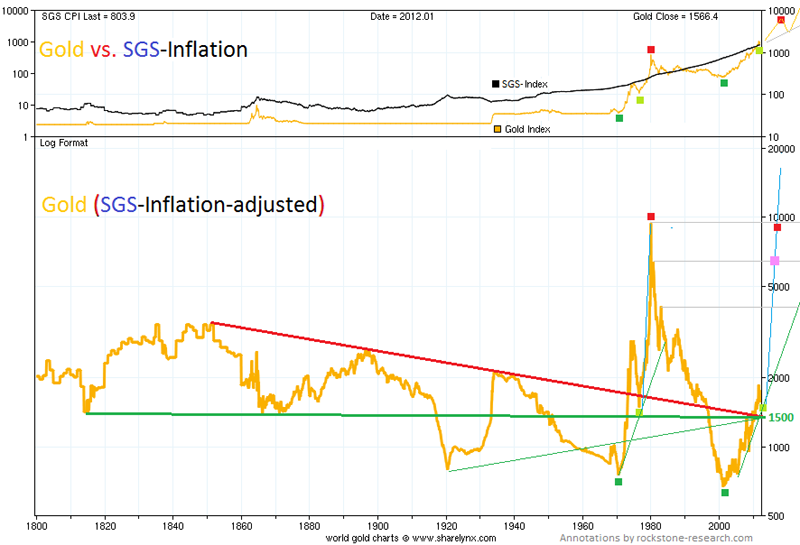
Mr. Bogner, in his more recent article, gives full consideration to the SGS inflation estimates, which I have often cited. Mr. Bogner believes we are now on the verge of the most significant upward breakout yet in the gold price, and his arguments are compelling. In brief, this is a very important and very recent article. Read "The Gold Megatrend" here.

LinkNote that another year has passed, and we are now looking at a previous inflation-adjusted 1980 high gold price of $9000 per ounce. It seems that the only remaining question is whether we are facing escalating inflation that can be contained by policies similar to those used by Paul Volcker in 1980, or whether we are on the eve of hyperinflation, in which case a $9000 gold price would be meaningless (it would rise much, much higher, but in this case, because of the final destruction of the currency in which it is valued).

As to the theme of this article, a return of animal spirits to gold and resource stocks, obviously such a trend has not been in evidence since the spring of 2011! However, Mr. Bogner remains optimistic on this topic also. Click here for his analysis of prospects for resource stocks, subsequent to the current retrenchment....

The gold tsunami is here, and it is advancing in multiple waves. The next advance is near.... and it looks likely to be the most powerful move in gold and gold stocks yet.

My gold tsunami posts are as follows:


There Is a Tsunami Coming in Gold

Gold Tsunami II: Anthropomorphizing Gold

Gold: Safe Haven in the Approaching Perfect Storm

Gold Tsunami III: James Kunstler's Use of the Analogy

Bond Prices: The Seismic Shift That Triggers the Gold Tsunami (IV)

Gold Tsunami V: The $23 Trillion Bailout... and Counting

Gold Tsunami VI: Looking for Patterns in Gold Price Advances

Gold Tsunami VII: This Is It


Gold Tsunami VIII: Gold Mining Stocks Now Participating
_