Tuesday, August 10, 2010

Let's Get the Patents Flowing!

10 August 2010

Bill Fleckenstein posted this thoughtful reflection on the need to foster innovation and creativity on August 9. I am reproducing his words here with his permission:

"I certainly have spent plenty of time over the last decade pointing out the problems and potential problems that the country faces, with none more severe than the protracted nature of the unemployment problem. As the financial crisis was unfolding in late 2008 and early 2009, I actually thought for a while that the incoming administration might try to do something intelligent regarding incentivizing jobs. That was 100% incorrect. The only incentives they have created are ones not to hire more employees, which has only made a bad situation worse. (See the op-ed in today's Wall Street Journal, "Why I'm Not Hiring," to see how the math stacks up against employers.)

"Thus, it is with great pleasure that I can point to something positive. In Friday's New York Times I read about an absolutely brilliant idea described in an article headlined, "Inventing Our Way Out of Joblessness." In it Paul Michel and Henry Nothhaft discussed the potential for breaking the logjam at the patent office and what that might mean. Not being an inventor, I certainly had no idea that the patent office was in quite such a state of disarray. Though I'm not knowledgeable on the subject, one of the authors to me has enough credibility that I think we can take him at his word, that being Paul Michel, who is former chief judge of the United States Court of Appeals for the Federal Circuit, which handles patent appeals.

"Their case is that, apparently, in the venture capital community 75% of startups require some sort of patent to get financing, according to a study they cite. Therefore, it's easy to see the connection between patents and new businesses. The sad, though not surprising, problem is that the patent office can't get enough funding to do its job. According to the authors, since 1992, Congress "has diverted more than $750 million in patent fees to other purposes," which has created a backlog of -- get this -- 1.2 million applications awaiting examination, over half of which haven't even been looked at yet.

"Michel and Nothhaft propose spending $1 billion -- which, when it comes to government these days, is chump change -- to get the patent office streamlined and staffed up so that it can process applications at a reasonable rate. The authors estimate that out of the backlog of 1.2 million applications, based on historical patterns, about 60% of those would result in issued patents, and perhaps as many as 137,000 would go to small businesses, with of course a more efficient patent office processing more patents in ensuing years.

"The net of all that, they feel, would be something on the scale of between 700,000 and 2 million jobs created, depending on what sort of estimates and variables one wants to use. Taking the midrange of their guess, or 1.5 million, that would mean that each job cost the government about $660, which obviously would be a mere pittance relative to the hundreds of billions dollars wasted on government programs that are useless.

"In addition, they suggested that, "Congress should also offer small businesses a tax credit of up to $19,000 for every patent they receive, enabling them to recoup up to half the average $38,000 in patent office and lawyers fees spent to obtain a patent." I would imagine there could be other incentives given on the tax front to help this process along, and I don't see any reason why a patent issued couldn't be fully reimbursed, assuming it ultimately met some sort of sales requirement.

"With so many massive problems staring us in the face, it is damn near criminal incompetence that a problem like this is allowed to fester. I can't see why anyone would be against this, as no one's ox needs to be gored."
_

Sunday, August 08, 2010

Understanding Inflation and "Deflation"

8 August 2010

If you at all follow Austrian economics and the role of money supply in inflation and deflation, you will know that we are not now, nor have we ever recently been, "at risk of deflation."

However, if this topic continues to confuse you, just read what Peter Boockvaar has to say. Then you will understand:

"With Treasury bond yields at or near historically low levels on one hand but with commodity prices near 8 month highs, and with the personal feeling that outside of a home, a computer and a flat screen tv, the cost of living seems to only go higher on the other hand, here is another perspective on the inflation/deflation debate. Since June 1981 when (Paul) Volker started to lower interest rates from 20% as high inflation rates started to fall, the absolute level of CPI rose 142% to the high in July '08 (90.5 to 217). Deflation is defined as a decrease in the general price level of goods and services but to quantify the current fall in prices, the CPI has fallen just 1% from its all time high. This tiny price move, notwithstanding we are still near an all time high in the daily cost of living, has led to talk that the Fed needs to do more to avoid deflation at all costs and thus create inflation via more QE (that is, "quantitative easing," or purchasing US treasury bonds with money printed out of thin air by the Federal Reserve, a practice which expands the "money supply" without adding to the wealth of the nation). An example, oil goes from $50 to $85 in one year and the next year falls 1% to $84.15 and we're told there is deflation and deflation is bad.

"The view is that with excess capacity and a lack of demand combining for softer prices, we must have even lower interest rates to spur more borrowing and thus more economic activity to increase demand and thus reduce the large output gap. Think about this, policy makers think we should raise the cost of goods and services in order to cure a lack of demand. The law of supply and demand says lower demand must be met by lower prices in order to get to the proper equilibrium. What the Fed really wants to do is create inflation in order not to deal with an over-leveraged economy in the most responsible way, either paying debt off or writing it down. They want us to pay off the debts with inflation. Inflation is a hidden tax on every single one of us and thus the corollary of deflation is a tax cut. Inflation is good for those who are highly indebted as those debts get paid back with inflated money while deflation or flat prices are good for those who save and have little debt and vice versa.

"In the state of deleveraging the US is in where the low cost of money doesn't matter much to an individual or a business in making spending and investment decisions, artificially low rates mostly spur just refinancing and higher commodity prices. While maybe or maybe not higher commodity prices make their way into government consumer price statistics, the commodity inflation is still there and has to be eaten by someone. Food for thought.

"CPI price level since June 1981."

Peter Boockvaar is the Equity Strategist at Miller Tabak + Co., LLC., in addition to his role as a salestrader on the equity desk. He is often seen on Bloomberg TV, CNBC, and Fox Business and is frequently quoted on Reuters, Dow Jones Newswires, Wall Street Journal, and The Associated Press. He joined Miller Tabak + Co., LLC in 1994 after working in the corporate bond research department at Donaldson, Lufkin and Jenrette. He is on the Board of Directors of Ameritrans Capital Corporation, a publicly traded Business Development Company. He is also president of OCLI, LLC and OCLI2, LLC, farmland real estate investment funds. Mr. Boockvar graduated Magna Cum Laude with a B.B.A. in Finance from George Washington University.

NOTE: If you want to "invest in inflation," you can, thanks to Nassim Nicholas Taleb and his colleagues. Universa Investments L.P. is forming a hedge fund positioned to profit through expected hyperinflation. Well, I don't think that's coming tomorrow. But it's a far greater risk than deflation, that's for sure!
_

Wednesday, July 07, 2010

Ben Bernanke Has Created Half of All the US Dollars in Existence - in Four Years!

7 July 2010

Quote without comment:


"The U.S. turned 234 years old yesterday, and yet over half of the nation's money supply was created since Helicopter Ben took over the flight controls four years ago. No wonder gold is in a full fledged bull market . . ."


-David A. Rosenberg Chief Economist & Strategist Gluskin Sheff + Associates Inc.

_

Monday, June 21, 2010

Moneyprinting as Policy: Winners and Losers

22 June 2010

As regular readers know, I often reference articles that I consider well though-out, particularly those that address current macroeconomic topics, as I am an individual investor saving for near-term retirement in a world that in my view punishes savers and rewards the reckless (or at least used to, until recently).

Steve Saville is among the economic analysts that I consider "very smart." He has recently written a short article, entitled "Inflation Update," that very simply and concisely sums up the present money supply and inflation issue in terms of the economic sectors that are most and least likely to "benefit" from excess central bank money printing. This is a notoriously tough area to call, as the winners and losers are different in every inflationary cycle, causing almost all pundits to be wrong on this topic almost every time!

Basically, Mr. Saville is saying that in sectors where there is excess supply, there will be no net benefit of Federal "moneyprinting." In fact, these sectors will sustain further deterioration. In our present situation (I'm referring primarily to the US, Britain and much of Western Europe), there are too many homes and too many labourers, thus precluding the flow-through benefits of inflation in these particular, already-beleaguered, sectors. That is, salaries do not rise and home prices fall, despite massive infusions of newly-printed dollars in circulation.

So what rises in value when the Federal Reserve Bank prints new money out of thin air? As I have often noted here, the costs of necessities are presently most under pressure, as they are relatively scarce in a world facing dramatically increasing Asian, Middle Eastern and, in selected cases, third world demand (in the case of commodity-exporting third world countries).

Mr. Saville refers in particular to energy and hard assets as sectors that will see price rises as a consequence of concerted global government-sanctioned inflationary policy, though many other necessities are also scarce relative to the vastly increasing quantity of printed (and electronically-created) money now in circulation (think insurance, government services, infrastructure, food, fertilizer, health services, postsecondary education, peace, safety and security - I could go on....).

The blowback?

According to Mr. Saville, the sectors nominally targeted by moneyprinting national central banks actually sustain net losses through inflationary policy --- which has most recently been in effect since the beginning of the Greenspan era at the US Federal Reserve in 1987. In the present case, home prices continue to deteriorate, and the cost of living rises for the long-suffering and now under-employed middle class.

I think Mr. Saville has succeeded in connecting a lot of dots in a few paragraphs - as well as showing that Austrian "true money supply" (TMS2 below) is still rising at a double-digit clip.

Read all about it here!
_

Friday, June 18, 2010

Gold: The Invisible Bull Market

18 & 19 June 2010

On February 11, 2007, I pointed out that gold's crossing the historic $800 threshold had elicited very few headlines, offering evidence that at that time, we remained in an early-stage gold bull market.

OK. Gold touched bottom at $255 per ounce for the last time on April 1, 2001 - over 9 years ago. That is, gold's bull market has persisted for almost a decade. Gold has gained in market price in every year since, with no exception, making it an ideal investment for cautious investors.

Today, gold set yet another record high, this time $1262.30. Ho hum. Apparently that's not news either. Certainly it's getting little media attention, and I've heard no one talking of it on the street.

Now, no doubt, coin collectors are wise to the precious metal boom - but hey, that's what the world's most desirable coins have always been made of, so coin collectors can only be identified as a special interest group.

And of course, the gold exchange traded funds are vacuuming up gold, sometimes at tons per day, accumulating gold holdings weightier than those of most countries. But these continue to be viewed as marginal investments by most financial advisors.

The Chinese government recently pronounced gold "too volatile" (that is, variable in price), to justify it as a primary investment. Meanwhile, China is steadily adding to its gold reserves and advertising to the public - through state-sponsored television ads - that it is a wise investment. Hmmm....

Most of today's investment advisors were trained, and certainly accumulated their experience, during the great equity bull market of 1982-2000. Well, no secret that equities have been in a bear market since. But the old conditioning seems to die hard, as almost all of today's advisories continue to push mainstream stocks. By my analysis, that backward-looking investment class could remain locked in a holding pattern for another decade to come, and a further equity "crash" is not out of the question!

So where should conservative investors look today?

Well, while stocks have gone nowhere this decade, gold has gained over $1000 in market valuation during the same period, adding almost exactly 400% to its cash exchange value during the past 9 years. I don't know what that tells you, but it suggests to me that gold might actually be a better investment than equities!

What do most people think of gold today? I most commonly hear others ask, "Well, gold has gone pretty high, can it go much higher?" Beyond this naturally sceptical response, many professional advisors suggest that gold is a risky asset class, that it "doesn't do anything - it doesn't pay dividends or interest," and that it "will soon start heading back the other way." It is "too dangerous," "too volatile," or "already in bubble territory."

WRONG.

Unfortunately, the professionals have been talking like this since 2001, missing the full 400% appreciation in gold's value.

For those who have been following my blog, you know that I am expecting an ultimate high in the gold price in perhaps the $5-6000 range in approximately 2019, assuming that we don't slip into hyperinflation - in which case the price of virtually everything - including gold - will be dramatically higher than today, due to a currency collapse.

So, can gold go much higher than the present $1200 mark? Based again on my personal analysis, I think we'll see $1300-1400 later this year, and $2000-3000 as soon as 2012. Another slow period is likely following the next strong run, I'd guess at some point following an interim 2012 high, perhaps through 2014 or so. Then, I think popular sentiment will shift to something very different than the early-to-mid bull market behaviour we are seeing today.

Between 2014 and 2020, my guess is that "everyone" will be talking about gold, most people will hold a significant portion of gold in their portfolios, and gold will gain over $1000 in some years during that period. But that will also signal the final years of the gold bull market.

That is, it's not too late to catch another decade-long 400% gain in the gold price. I think it's going to do it again next decade!

It is an ineluctable quality of human psychology that we are late to detect trends. And, just when gold is truly popular, another asset class (possibly bonds and equities again) will be stirring in the beginnings of a new bull market - and most members of the public will be left behind - again!

My advice. Don't be left standing and watching. Examine the evidence for yourself, and think big - think gold for the decade to come!

And... enjoy the ride (which will be choppy at times)!

19 June 2010:

P. Radomski, my favourite technical analyst, does not see gold topping here. Summer is definitely a slow season for gold and gold stocks overall, as Adam Hamilton has shown (click here), but Radomski sees technical grounds to suggest that gold can continue to climb through mid-July. So even if you're a strategic investor, now may still be a good time to be holding - or even purchasing - gold investments!
_

BP's Fateful Discovery: Bottomless Liability

3 & 18 June 2010

How does BP stay in business here? I'm honestly not sure why anyone is buying the stock these days, even with the company's market capitalization slashed by $70 billion or so (it has bounced back up from $36 to $39 the past two days).

The problem is liability. The greatest Gulf of Mexico oil spill in history has created unending damages to wildlife, ecosystems and countless human activities - with human health, fisheries, leisure travel, waterfront real estate (and property values) impacted, presumably for many years to come.

No corporation (or mega-corporation), BP included, could possibly ever muster the funds to reimburse all affected for the damages unleashed by this disaster. Apparently 1/6 of all British dividend payments originate from BP. I don't see how that lasts either.

I haven't seen much discussion of this issue. There was talk on CBC radio today about the immense value of BP's assets - but that calculation disregards the company's liabilities. We saw
Johns Manville plunge into bankruptcy over asbestos insulation claims.

BP in the gulf is bigger than that - far bigger by at least an order of magnitude. Once again - the US taxpayer will foot the bill, and I predict that many of the damages will never be paid (think about Florida Gulf Coast real estate values, just for a starter).


Once again, we are facing a paradigm shift, and the market hasn't caught up with the concept of "bottomless liability." Take my word for it, this case is not over until BP is in bankruptcy court. No corporation on earth could bear liability on this scale.

Click here for one forum that is discussing this somewhat complex issue. For example, BP's total liabilities may be limited by law, at a small fraction of the total damages.... As to insurance coverage - they insure themselves through a sub-venture known as "Jupiter."

18 June 2010: For more on oil spill clean-up, ask Cecil, at "The Straight Dope." The good news - oil is biodegradable, and natural bacteria are probably more effective - and certainly safer - than chemical dispersants. The bad news - in low oxygen areas, not much degradation can occur.

Re today's news. Will a $20 billion fund cover "bottomless liability?" I wish, but I don't think so.... As of today, $20 billion is 20% of BP's total market capitalization of $99.28 billion. I think BP can be restructured, but I still see this one going to bankruptcy court.... Very bad news for British investors - to run into the full force gale of US tort - and possibly criminal - law! How can any company survive the unstinting assaults of the combined US political and legal systems?

Interestingly, Douglas McIntyre proposes that BP made a mistake to cave-in on the $20 billion fund. Read about it here.

The New York Times thinks that BP may be facing a total bill on the order of $56 billion, but that BP can generate enough cash to pay the cost, assuming all goes well. I see two problems with this analysis: (1) bottomless liability will continue swelling the amount to be paid, and (2) it is seldom
that everything goes well for anyone in the real world which all of us inhabit. Read the NYT article here.

BP P.L.C

After Hours: 31.62 Down 0.09 (0.28%) 7:59PM EDT

Last Trade:31.71
Trade Time:Jun 17
Change:Down 0.14 (0.44%)
Prev Close:31.85
Open:32.20
Bid:31.48 x 200
Ask:31.66 x 100
1y Target Est:47.66
Day's Range:31.25 - 32.46
52wk Range:29.00 - 62.38
Volume:111,455,729
Avg Vol (3m):43,656,400
Market Cap:99.28B
P/E (ttm):4.99
EPS (ttm):6.36
Div & Yield:3.36 (9.90%)
BP plc (BP)
_

Friday, June 11, 2010

My Reply to James Galbraith

11 June 2010

In an interview with Ezra Klein (excerpted by Jonathan Lundell, see below), James Galbraith has maintained that "the danger posed by the deficit is zero." Well, it's an interesting idea... but in my view, this particular idea's time is limited.

Following are Galbraith's interview excerpt, and my reply:

Ezra Klein – Galbraith: The danger posed by the deficit ‘is zero’


James Galbraith is an economist and the Lloyd M. Bentsen Jr. chair in government and business relations at the University of Texas at Austin. He’s also a skeptic of the prevailing concern over America’s long-term deficit. With many people now comparing America’s fiscal condition to Greece, I spoke with Galbraith to get the other side of the argument. An edited transcript of our conversation follows.


EK: You think the danger posed by the long-term deficit is overstated by most economists and economic commentators.


JG: No, I think the danger is zero. It’s not overstated. It’s completely misstated.


EK: Why?


JG: What is the nature of the danger? The only possible answer is that this larger deficit would cause a rise in the interest rate. Well, if the markets thought that was a serious risk, the rate on 20-year treasury bonds wouldn’t be 4 percent and change now. If the markets thought that the interest rate would be forced up by funding difficulties 10 year from now, it would show up in the 20-year rate. That rate has actually been coming down in the wake of the European crisis.


So there are two possibilities here. One is the theory is wrong. The other is that the market isn’t rational. And if the market isn’t rational, there’s no point in designing policy to accommodate the markets because you can’t accommodate an irrational entity.


Laurence R. Hunt / Jun 11, 2010


How about let’s NOT design policy to accommodate the (irrational) market, but let’s design policy to create a stable economy, and let the market adjust on its own (freely AND irrationally). In my view, the problem of the past two decades has been shaping policy around market moves. Rather, let the market move around policy – we have had it backwards.


Low interest rates punish savers and fuel speculation, and when speculation becomes the lifeblood of the market, well, you’ll have irrationality for sure! The “market” will not like economic sanity, but the longer we put off the day of decision, the greater the imbalances grow – as perhaps the past 20 years have already shown. And – long-term interest rates will climb.


We are just talking about glaciers here. There are vast rivers beneath the surface of the glaciers, and they are masked by the glaciers’ comparatively limited rates of movement. But at some point, the glaciers break off – and at some point, long-term rates will rise – and the US government will be forced to balance the budget. If anything is a demonstration of the long-term principle of karma – it is the market. And then suddenly it looks rational again – the corrective process in action!

_

Tuesday, June 01, 2010

Gold - Are You Watching?

1 June 2010

It could be time for gold to make its next big move soon:

Radomski: Gold To Hold Well Even If Stocks Plunge Like In 2008

This would fit with the Adens' model too, and we should hear from them next week.

Looks like $1400 gold to me, with a peak in July or so.

This fits with my model posted last fall, except we are now looking at a peak perhaps in July 2010, versus my original supposition that it would come in March or May this year.

The gold market always throws in a twist or two - or three or four....

The gold tsunami continues.

I'm still expecting the big surges in 2012 and 2019 (approximately).
_

Monday, May 17, 2010

Mingus - Wednesday Night Prayer Meeting

17 May 2010

Life is short. Or maybe not. It depends in fact on your perspective and personal take on the question. But life does not continue forever.

What must we do?

Certainly every day we must do something we love.

What did Charles Mingus love? Well, I'm not aware of the entire scope of his passions, but the man certainly loved making music.

Throughout my life, I've often heard Mingus' music mentioned by others, most notably, perhaps, because Joni Mitchell referred to him as "mellow, fantastic," and recorded an album with him. As it happens, I didn't listen to that particular album by Joni Mitchell. Nor did I listen to Mingus' music until recently.

What have I learned?

We have to stretch and try new things to discover the the further reaches of our individual and collective souls.

After all these years, I have just discovered Mingus' Wednesday Night Prayer Meeting, recorded on his Warner Jazz (Atlantic) album, Blues and Roots. (As I listen more, I am inclined to recommend the "alternate take," into which Mingus and his companions invested just a little more swing....)

Wow!

Now I understand why Mingus' music has interested people over all these years. Using the complex and multi-perspectived tools of tone, timing and rhythm, Mingus calls to mind an old-time prayer meeting while at the same time exploring the boundaries of what it is possible to do with improvisation and experimentation in music. It works - dramatically well.

At this moment in time, I cannot listen to Mingus' Wednesday Night Prayer Meeting without being entranced - captured by Mingus' musical erudition and bravado. What a masterwork! What pleasure for those who are open to Mingus' tonal experimentation!

Mingus has opened a new world to me - one that is just a little bit broader and more majestic than the world I previously inhabited. That is entirely satisfactory - for now.

In order to stay open, of course, I must continue to explore and experiment, as did Mr. Mingus himself.

But for this week, I can only counsel the reader. Listen to Mingus. Open your ears. Widen your mind. Expand your world.

You will not be disappointed.

Aaron Cohen's critical review follows:

"Bassist Charles Mingus was always ready for a good fight. In the liner notes to this disc, Mingus says he wanted to respond to critics who said he didn't swing enough. And reply he did. Mingus gave whoever these absurd quibblers were some of the most ecstatic blues ("Moanin'" and "Cryin Blues"), gospel ("Wednesday Night Prayer Meeting") and Dixieland ("My Jelly Roll Soul") the jazz world has ever heard. Along with his striking original compositions, the instrumental combination in Mingus's nonet remains unconventional: the frontline included four saxophonists and two trombonists without the counterweight of a trumpeter. The leader's sliding octave bass lines and percussive slaps are totally rollicking, and the wild abandon in the group's playing is irrepressible."
_

Sunday, May 09, 2010

US National Deficit - Think $5 Trillion Annually!

9 May 2010

I often comment on other posts that contain within them facts which are so jaw-dropping that silence is impossible - for me at least!

From an old friend, John Williams, who specializes in keeping statistics far more reliable than the massaged and distorted numbers released regularly by the US government, comes the seemingly inconceivable fact that the US government is running deeper into the red by $4.5 to $5 trillion dollars per year (not the official and still mind-boggling $1.4 trillion annual figure).

What?

Believe it or not, Mr. Williams, a meticulous statistician, simply crunched the numbers, and this was the figure he got. Why did I round this up to $5 trillion in my article title? Because important fundamental factors are steadily growing more negative - specifically the rising rate on US treasury bonds, which will gradually force the US government to pay higher and higher interest on its debt denominated in bonds, most of which are now sold to international investors (no longer true, the old saw that "we owe it to ourselves").

What exactly is Mr. Williams telling us? I quote from his Gold Report Interview:

"If you look at... GAAP-based statements and include in the deficit the year-to-year change in the net present value of the unfunded liabilities for Social Security and Medicare, what you'll find is that the annual operating shortfall is running between $4 and $5 trillion; not $500 billion as we saw before the crisis or the $1.4 trillion that they announced for fiscal 2009. Now to put that into perspective, if the government wanted to balance its deficit on a GAAP basis for a year, and it seized all personal income and corporate profits, taxing everything 100%, it would still be in deficit. It can't raise taxes enough to contain this. On the other side, if it cut all government spending except for Social Security and Medicare, it still would be in deficit. With no political will to contain the spending, eventually the government meets its obligations by revving up the currency printing press."

Yes, you read it correctly. If US citizens paid 100% of their income, and US corporations paid 100% of their profits in taxes - it would not raise enough funds to meet the real annual shortfall!

Hmmm.

Is this not the standard definition of bankruptcy? Yes, I think so.

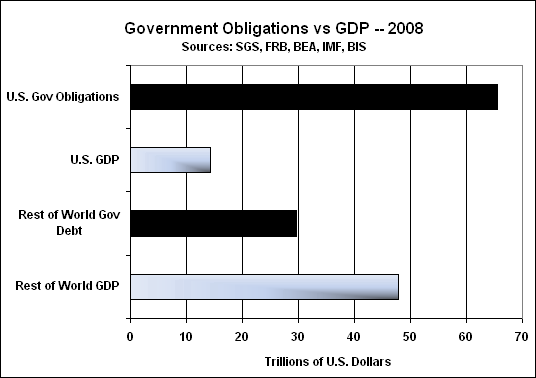
For your edification, I have included several 2008 charts from Mr. Williams' Shadowstats site illustrating the scale of US unfunded liabilities in proportion to GDP. In short, the US government has a much higher liability to GDP ratio than the balance of the world, and this is the crux of the problem.

For a general review of US debt issues, click here for an excellent and detailed article in Wikipedia.

Watching the government-level default of Greece on its international debt obligations, presently playing out on the world stage, offers some instruction as to what happens when governments "go bankrupt." It is chaotic and fear-inspiring. Bear in mind, the Greek economy, with a nominal GDP of $343 billion (2008), making it the 27th largest in the world, constitutes only 2.08% of the combined fiscal activity of the European Union (that figure is $339 billion in terms of purchasing power parity, or PPP, the metric by which China is rapidly catching up to and overtaking the US in financial power). Greece has defaulted on its obligations about half the time since it became a democracy, so the Greek economy has never been particularly robust.

So, how large is the US economy, compared to the Greek economy? Well, the US, the country by which PPP is oficially measured, is the largest economy in the world, with an annual GDP estimated at $14.266 trillion in 2009. That is, the US economy is 41.6 times larger than that of Greece, or almost as large as that of the combined European Union, with an annual GDP figure of $16.447 trillion.

For the sake of interesting statistics, note that while the GDP of China is about1/3 that of the US ($4.91 trillion in 2009, third in the world), in purchasing power parity terms, the Chinese economy has now reached the $8.77 trillion level, making it the second largest national economy in the world with respect to the quite meaningful PPP metric.

Suffice it to say that Greece is small, the US is big, the European Union is very big, and China is now playing in the big leagues as well.

So if the Greek crisis is creating this kind of global firestorm, then what are the implications of the bankruptcy of the US?

Hmmm (again)...

That could be a giant-sized problem...

Mr. Williams foresees a hyperinflationary great depression for the US. Maybe - I don't know about things like that.

Here's what I do know. The news media routinely apply the phrases "global reserve currency" and "safe haven in time of crisis" to the US dollar.

Perhaps that will not always be the case. Marc Faber has commented that we have already returned to a global gold standard for functional purposes. Mr. Faber states, "I think we already have now a gold standard… created by the market place. We have the (exchange traded funds) that have proliferated and we have more and more physical buying of gold."

That's an interesting idea....


We all know that the markets can remain irrational longer than we can remain solvent (J. M. Keynes). But can the markets remain irrational longer than the US government can remain solvent? I don't think so. At some point, phrases such as "global reserve currency" and "safe haven" will not apply to the US dollar.

The good news, of course, is that those terms have been applicable to gold for thousands of years of human history. Guess what? Nothing has changed.

It's a no-brainer. Own gold and sleep well at night. Pleasant dreams....

P.S. Gold's next stop = $3000 per ounce in 2012? Maybe - click here.

Gold headed to $6000 or higher by 2019? Click here.
_