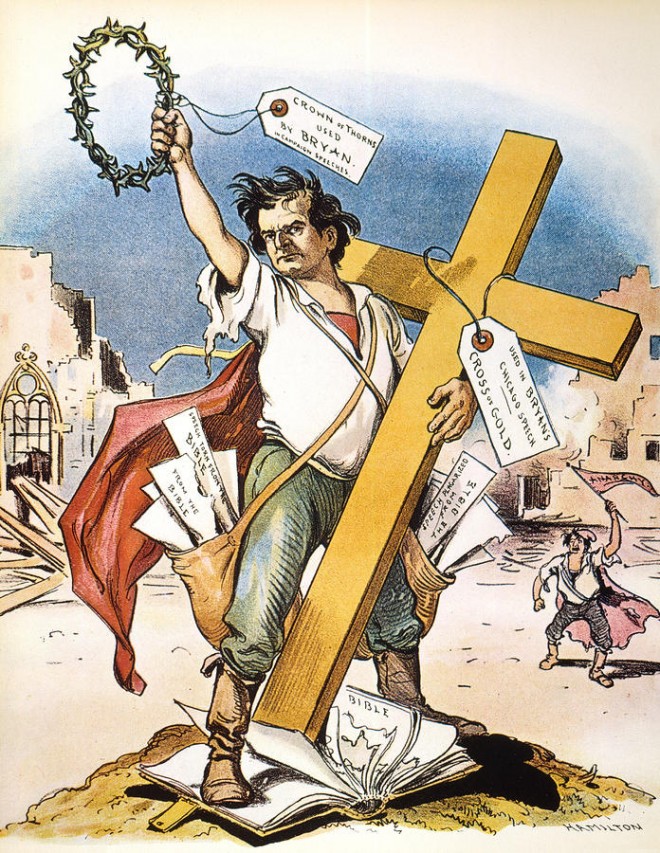
This wonderful graphic comes from Jim Sinclair.

Take your pick.
There is now little difference remaining between the two.
And... think before you act!
_

 Since the nations of the world, led by the example of the United States, aboandoned the gold standard, all of them have allowed their currencies to decay at a steady clip. We call it "inflation," perhaps a euphemism. My suggestion, we should call currency destruction what is is, "currency decay."
 In brief, this is why the European Monetary Union is failing. Greece has always permitted a rapidly decaying currency, as Greek citizens have a habit of taking long holidays, retiring at 60, not paying income and property taxes, and not even paying for government-provided services, including electricity. Similarly, Spain, Portugal and even Italy are "relaxed" when compared to the more industrious French and German economies.
 I am not a conservative, but I also differ with many liberals, so I'm not sure what category I fall in. I believe in free markets, but our present market is manipulated. Our corporate "titans" seem to manage businesses for themselves, not for their shareholders. General Electric Corporation, as an example, has shed 58% of its value since the year 2000, and the broad markets have punished shareholders for 12 years. The ultra-rich are taking everything private, and closing out public participation in ownership of assets. Governments are adding gatekeepers and regulators, and shedding service providers, builders and maintenance workers. The income tax code is a Byzantine labyrinth that favours the rich and punishes the middle class. We are conducting costly wars on drugs, privacy and terror. Paul Krugman is calling for more debt, which cannot possibly work long-term (look at Japan for a trip down that road). Unions are losing the battle to protect their members, but winning the battle to prevent young people from entering the workplace. I hope you grasp my dilemma. It seems that everyone on both the left and the right is doing exactly the wrong thing. My personal investment strategy (precious metals) is predicated on the assumption that decision-makers everywhere, given a choice, will take action without consideration of long-term consequences. Our governments are accumulating debts that the young cannot pay, and the prospect is that we shall all be taxed at ever greater levels in order to fund the ballooning cost of a world that none of us wants. There are of course bright spots out there, but the broad trend is as negative as I have ever seen.
 Better Mr. Keynes' trenchant observation, "Markets can remain irrational a lot longer than you and I can remain solvent!"
 Rather, I argue that markets are instinctual beasts.
 However, as the seasons change, the instinctual behaviour of the robins will alter as well. Based on my own experience, after nest-building comes the territorial defense of the anticipated, and then the newly-hatched young.
 And of course, the seasons change again, as they do in their cycles, and soon enough, all of the seasonal brids will leave, flying south. Those invested in nest-building materials will experience a "bear market."
 Then it shall be widely assumed by the market that, as robins no longer live here, robins simply aren't a good investment. Until, of course, they return the following spring. The instinctual beast does not think that far ahead!
 Bill Fleckenstein observed this week, "the market is playing checkers, not chess." It thinks ahead, but only in somewhat obvious ways.
 Now it is no secret that inflationary monetary policy relies on low interest rates to enable the jugglers to keep all their bowling pins in the air.
 Now, when the instintual behaviour of the market next shifts, what should we expect?. In my view, bonds will become the next "risky" asset, and investors will begin to flee them in droves, with bonds emerging as "the next bear market." Today's ultra-low, even record-low bond interest rates will prove unsustainable, just as did investing in the nest-building business.
 Well, bonds will remain in a bear market, probably for a very lenghty period. The stock market, already dead in the water for 12 years, is not set to recover any time soon.
 The HUI is not going to retest its 2008 lows, but the HUI:GOLD ratio is. Looks like we're gaming for a double (or triple, if you prefer) bottom on this chart, meaning the HUI:GOLD ratio probably falls to the 2000/2008 lows (.204). We're now at .243, so that's actually only four decimal points to go. No big deal (ha!).
 Assuming gold swoons to $1400 or so, or stays higher, that means the low for the HUI would be 275-300, vs its low of 150 in 2008.
 Hold on everybody. It will be steep and hard, but relatively brief at this juncture!
 NOTE: Dan Norcini has thoughts similar to my own. Click here for Dan's thoughts on the current rout (a consequence of the parabolic September 2011 blowoff in the gold price, by the way).

 However, Mr. Krugman's recent comments on the imminent necessity of Greece's leaving the Euro as a shared common currency are of importance.
2. Huge withdrawals from Spanish and Italian banks, as depositors try to move their money to Germany.
Many economists are concerned about the possible implications of a Greek withdrawal from the Euro, now considered probable, based on the dramatic "anti-austerity" results of the recent Greek election. The US federal deficit remains high because tax receipts are down and expenditures are static (that is, little growth, but little corresponding structural reform).
 (1) Trim the bureaucracies that determine who pays and who receives federal funds (they are massive and grow like Topsy).
 (2) Simplify receipts with a flat tax (goodbye IRS, you can let 90% or more of the staff and all of the exemptions go).
 (4) Retrain the bureaucrats with productive skills, starting with growing gardens and flipping veggie burgers!
 That's it. All better.
 To my knowledge, Mr. Bernanke has never done this before. He has laid out his delusional belief system for all to see. (Ben Bernanke, a former Princeton University professor, is the Chairman of the US Federal Reserve, a private corporation which manages money supply and interest rates in the US.)
 Joe Weisenthal, an intrepid reporter with Business Insider who has a notable nose for news, summarized Mr. Bernanke's first lecture on the history of the Federal Reserve as follows. Note that Mr. Bernanke began by attacking the gold standard. That was mistake number one. Mr. Bernanke's multitudinous errors proceed from there....
 Mr. Wiesenthal, who is indefatigable, summarized Mr. Bernanke's speech as follows:
 I replied to Mr. Weisenthal's summary as follows:
 "To be clear, von Mises dealt with all of Bernanke's points half a century ago. However, knowing that Mr. Bernanke thinks this way helps me sleep more soundly at night as a gold investor. It's amazing how the smartest people can rationalize the most egregious behaviours.
 When you add the off-balance sheet debt (much of it high-risk loans to the public) to the $10.4 trillion in official government debt held by the public, you get a $24 trillion figure, in contrast to an annual GDP figure of $15 trillion. (That is, the above chart overlooks this $13-14 trillion off-balance sheet amount.)


