Saturday, January 18, 2014

Gold's 1980 High – Think $5000 – No $9000 – per Ounce – or Higher

15 July 2007 - Updated 18 July 2007, 6 & 10 April & 29 July 2008, 13 & 18 November 2009, 18 January 2010, 13 & 31 January, 15 February & 15 May 2011, 22 April 2012; 20 January, 22 February & 14 July 2013; 18 January 2014

The following article was originally published on July 15, 2007, so please read this as a historic document. More recent comments are added at the conclusion of the original post.

Jay Taylor has just posted a new inflation-adjusted estimate of gold's peak 1980 price.

As readers of this blog are aware, the price of gold rises in inflationary times.

Readers will also be aware that governments purposely and systematically understate the amount of actual inflation so as to make it possible for debtors everywhere – and governments are the greatest of all debtors – to repay obligations in a devalued currency, thereby enabling the ongoing operations of a debt and liquidity-based economy.

As a reader, you will also be aware that such an economic strategy punishes savers and rewards debtors by making saving unprofitable, thereby fuelling borrowing, discouraging saving, and creating asset bubbles (government sanctioned Ponzi schemes, if you will).

(Inflating asset bubbles entice citizens who would otherwise be savers to invest their devaluing cash in risky assets, thereby creating economic instability as an inevitable correlate of monetary inflation.)

The US government's official figures acknowledge that 1980's peak gold price was not the nominal $887.50 intraday high figure that those of us old enough to remember can recall from that era, but an estimated $1,459.63 US dollars.

Given this figure, we could conservatively expect gold to revisit a price near $1500 per ounce at some point in the upcoming years, based on cyclical fluctuation alone.

However, Mr. Taylor reminds us that the government inflation estimate is in fact grossly understated. According to him, Boston-based money manager Antony Herrey has compiled a chart of the inflation-adjusted gold price using not the government's own CPI statistics, but rather much more accurate inflation numbers compiled by economist John Williams.

Mr. Williams estimates that today’s US inflation rate is closer to 10% than the official (and entirely non-believable) government-reported 2.7%.

Mr. Herrey’s readjustment of the historic gold price based on the actual (non-manipulated, if you will) rate of inflation shows that gold in fact peaked at an inflation-adjusted amount of about $5000 in 1980.

The implication of this recalculation is that by normal cyclical fluctuation alone, it is reasonable to expect the current gold bull market to top out somewhere higher than $5000 per ounce.

Why higher than $5000 per ounce?

Because inflation will continue as the gold price rises.

So at today’s $666.00 per ounce, is gold cheap or expensive?

I think you can figure that one out.

On my advice, do not invest your devaluing cash in the current stock market and real estate bubbles (or other risky assets) presently exciting North America and much of the developed and developing world, but preserve your savings through the time-honoured store of value offered by precious metals – gold and silver.

Gold is up 150% from its 2001 low. But it can grow a further 750% from today’s levels – in real cash terms – before equalling its inflation-adjusted 1980 peak value.

This dollar-value advance would represent a 2000% or more (non-inflation-adjusted) cash gain from the 2001 low near $250.

Another way to think of it is that in true 1980 dollars, gold’s current market price is not $666.00 per ounce, but a reverse inflation-adjusted $113.00 (1980) US dollars per ounce.

The stock market by and large is trading in bubble territory by historic metrics. Real estate in many North American locations is also in bubble territory. Citizens everywhere are borrowing at a record clip and pouring their savings into ever-riskier assets – with today’s fads being hyper-leveraged hedge funds and the privatization of public companies by pension plans and private equity groups.

Do not let official government inflation policies force you into risky assets to preserve or increase the value of your savings.

While asset bubbles are over-valued by definition, gold remains radically undervalued, and will be a secure store of wealth for many years to come.

It is not that the price of gold is rising. It is that we are re-evaluating the worth of gold in terms of the declining value of “paper” (or digital) money.

Governments around the world can create new money through a series of computer key strokes.

But until the alchemists succeed – or until nuclear fusion advances far beyond today’s levels of sophistication – so that we can create gold at will from “base substances” – gold and silver will remain stores of value that are essentially impervious to the irresponsible inflationary policies of our governments around the world.

By the way, commodities generally also look very cheap today in inflation-adjusted terms, despite doubling on a broad measure since 2001. The chart below, from Puru Saxena, graphs commodity prices from 1954 through February of this year, with the inflation adjustment based only on the US government's profoundly muted official inflation numbers.

The Reuters/CRB continuous futures commodity index peaked in 1973 at $1048 in nominal "2007 US dollars." If we are to believe John Williams' inflation numbers, the real 1973 commodity index peak would have been in the $3-4000 range in 2007 US dollars. Today's CRB continuous futures index amount – just above $400 – therefore looks very much like a bargain from that perspective – and signals that commodity prices will run much higher before the world's demand for commodities has been sated.

Addendum - 6 & 10 April 2008: This post is the most frequently visited on my site, so I have added links to related information here, where more visitors are likely to find it. Mr Williams has recently updated his inflation-adjusted 1980 gold price to $6030, in order to reflect recent further inflation of the battered US dollar, which, as you know, is unwinding quickly at this time. Click here for more current information.

If you're looking for current gold prices - right up to the minute, visit Kitco.com. Kitco also has a wide selection of historical charts dating back as far as 1792. Kitco also sells gold in various forms, and can hold it for you, with delivery at a later date - allowing multiple purchases over time with only a single delivery charge.

And if it's technical charts you need, go to Stockcharts.com, though these charts date back only to 1990.

For further study of associated underlying factors, such as accumulating debt and escalating money supply, click here.

For more information about Canadian gold investing, click here.

For information about secular trends, click here.

For information on investment issues that relate to gold mining, click here.

For links to precious metal investment advisories, please view my links section to the right.

Could the price of gold rise higher than $6000? Click here for some speculations about a $9000 or higher gold price.

How should gold be priced today? My October 2008 estimate is in the $1600 range. Click here for this article. Bear in mind that "should" and "is" are two different ideas....

13 November 2009: Like the idea of $5000 gold? I'll be honest with you, any estimate of numbers even a few years in the future depends on countless economic unknowables, including the level of fiscal responsibility of all governments around the world (don't get overly optimistic), cumulative global central bank monetary policy, issues of war and peace, free or impeded trade, etc. So who really knows? Not I.

But here is an unlikely person who likes the $5000 number: Martin Armstrong, a financial theorist, former hedge fund manager and convicted Ponzi schemer (see Wikipedia entry here), likes the $5000 number for the year 2016. I can't tell you much about wave theory, not do I have personal knowledge of Mr. Armstrong's character, but I can attest that his fundamental analysis is not entirely off the mark. He states: "Gold has been among the most hated subjects by the socialists, because with each dollar that it advances, it reveals the delusion that they seek to live within."

However, in my view, Mr. Armstrong's critique, with its focus on the shortcomings of socialism, goes nowhere near far enough.

In correction to Mr. Armstrong, who makes a distinctly partisan argument, let me add that in my view, the fundamental problem is hardly with "the socialists" alone - as this group certainly remain a minority faction in North America and through most of the developed world. Particularly here in North America, it is unlikely that it will be the socialists who do us in....

Basically, every party and faction that seeks to resolve its issues through government rescue of a particular sector of the economy is equally in trouble, and that goes for the belligerent folks at the military-industrial complex, the Wall Street speculators who live for the next government guarantee, policy easing or bailout, the CEOs and executives who award themselves and their cronies obscene salaries and bonuses, the elected representatives who vote themselves comfortable pensions, and the financially reckless at all levels and strata of society from the poorest to the very rich.

Transferring funds from one sector of society to another sector of society through government intervention, exploiting savers and investors to pay off executives and managers, borrowing money we do not have and cannot pay back, billing our present expenses to future generations, and printing money out of thin air, are not sustainable strategies for wealth creation (though all are widely practiced today).

In fact, permit me to restate Mr. Armstrong's words as follows: "Gold has been among the most hated subjects by the financially irresponsible at all levels and in every sector of society, because with each dollar that it advances, it reveals the delusion that they seek to live within."

You heard it here. This is not about socialists. It is about all of us. Let's get our act together and start balancing budgets, promoting savings and investment rather than spending and borrowing, and setting aside reserves for the future rather than bilking our trading partners, shortchanging the purchasers of government bonds, and robbing our children and grandchildren.

I'll say it another way, let's make life easy for savers and investors, and difficult for borrowers and spenders. For a start, let's raise interest rates, not lower interest rates. Rather than taxing those who save, let's subsidize - or at least get out of the way of - private investment in legal and ethical business ventures of all kinds by those who set aside a portion of their funds for other than immediate uses.

That being said, Mr. Armstrong's select monograph on $5000 gold can be found here, courtesy of The Business Insider. Think what you like about his personality or his ethics (I do not condone securities fraud!). But Mr. Armstrong might possibly be on the right side of the trade when it comes to setting future gold price targets.

(More theoretical and critical articles by Mr. Armstrong can be found here.)

18 November 2009: Depending on your preferences, here is another analyst calling for $5000 gold. This time around it's Marc Faber, the Swiss-born trader who has resided in Asia for many years. Mr. Faber is arguing that gold is a better buy now, at over $1100 per ounce, than when it traded at $300 per ounce 6-8 years ago.

Faber states:

"I don’t think that you’ll see gold below $1,000 per ounce probably ever again. So I’m quite positive. Maybe, gold at this level is a better buy than it was at $300 per ounce in 2001.
"At first glance, the idea that gold priced at over $1,100 an ounce is 'a better buy' than when the metal traded at about a quarter of that price seems preposterous. But, when you think about it just a little bit (i.e., what constitutes a 'better buy' and how the fundamental factors have now swung so decidedly in gold's favour), maybe it isn't a crazy idea at all.


"I wouldn't be surprised if, in another eight years - in 2017 - the yellow metal fetches $5,000 an ounce or more which, by my math, would make it a better buy. Gold may not rise as much against other currencies, but, after almost a decade of trillion dollar deficits, that almost seems like a slam dunk when the measuring stick is the U.S. dollar."


-----------

Lots of talk right now about longer-term gold targets. Of course, gold can go to infinity if the US dollar loses all of its value. I'm not predicting that, but the losses in the dollar are striking over the scale of the past century (during which the Federal Reserve has had a license to print money).

Dylan Grice, at Societe General, sets a target of $6300 per ounce. I think he is in the ballpark, though his methodology doesn't make sense to me. He is working out how much gold the US has, and what the price of gold would have to be to back every US dollar in existence. Here's the problem - the US government is not going to give anyone gold on demand in exchange for its currency.

Nonetheless, here is Rolfe Winkler's take on Grice's idea.


-----------

The $5000 figure is now popular. Martin Hutchinson, a market historian writing at Prudent Bear, observes, "The opportunity for the world's central banks to change policy and affect the economic outcome has been lost. The world economy is now locked on to an undeviating track towards another train wreck."


What is Mr. Hutchinson's gold price target? Again, $5000.

An esteemed historian in his own right, Adrian Ash explains: "Hutchinson sees a repeat of 1978-1980 now unfolding, with the price of gold vaulting to perhaps $5000 an ounce by the end of next year."

This rate of development of the crisis is a little fast for me....

Mr. Hutchinson sees it like this, however, "If expansionary monetary and fiscal policies are pursued regardless of market signals, the US will head towards Weimar-style trillion-percent inflation... As I said, a train wreck. Probability of arrival: close to 100%. Time of arrival: around the end of 2010, or possibly a bit earlier. And, at this stage, there's very little anyone can do about it; the definitive rise of gold above $1,000 marked the point of no return."

Mr. Ash does not oppose or endorse Mr. Hutchinson's one-year $5000 projection for the gold price, but he concludes, "In short, if you think buying now feels a hard decision, what would you think 50% or 100% higher from here....?"

You know, that's worth thinking about! Click here for Adrian Ash's full article at Seeking Alpha.

18 January 2010: More articles on $5000 gold:

"The Five Reasons Gold Will Hit $5,000"

"Gold May Rise to $5,000 on Inflation, Schroder Says"

"Peter Schiff makes the case for $5000 gold"

"Will Gold Reach $5000 an Ounce?"

"$5,000 Gold?"

"$5,000 Gold In The Future?"

"Could $5,000 gold be too low as dollar loses value?"

"Global Stock Market Forecasts - Shanghai Index 30,000, Gold $5000 and DJIA 17,000"

9 May 2010: Gold's next stop = $3000 per ounce in 2012?

Maybe - click here.
(Gold Decouples on International Debt Crisis Concerns - Gold Forecast to Reach $3,000)


Mary Ann and Pamela Aden are also currently considering a 2012 peak target in this range, and suggest that a subsequent peak in 2018-2019 could be several thousand dollars higher.

Enjoy!

13 January 2011: Today is my father's birthday, so I dedicate this post to him.... There is now so much material on this topic, I hardly know where to direct you. But for an overview, one diligent researcher has gone to the trouble of tracking down every known gold price prediction (and here I'm discounting those looking for $680 gold in 2014. That is NOT going to happen through any conceivable course of events - apart from the synthesis of gold in a fusion reactor or the earth's collision with a golden asteroid!).

Click here for Lorimer Wilson's unique overview: These 110 Analysts Believe Gold Will Go Parabolic to $3,000 or More! (The link may be somewhat circular, as the present article is also mentioned.) Mr. Wilson's article may be of special interest if there are particular analysts that you prefer to follow.

31 January 2011: Here is an up-to-the-minute gold price estimate - following Alan Greenspan's recent recommendation that we reconsider a gold standard. The US gold hoard - the largest in the world - will back the entire US money supply at a rate of $6300 per ounce. It sounds arbitrary, but if the US were to adopt a true gold standard (every dollar in circulation backed by non-printable, non-inflatable physical gold), that's how many dollars is would take to purchase a single ounce of US gold holdings..... Note that Mr Greenspan joins Robert Zoellick of the World Bank, Howard Buffett (but not his son Warren), Jim Grant and Thomas Hoenig of the Kansas City Fed in making this recommendation. Think about it... a gold standard for our ever-inflating money supply, and $6300 gold.

15 February 2011: The current SGS (Shadowstats) inflation-adjusted price for gold's previous 1980 peak value (based on gold's $850 close vs. its $887.50 peak intraday price) is now... get this, $7824 per troy ounce (courtesy of The Dollar Vigilante). And, of course, as inflation increases towards, let us say 2019, we are likely to move above not only an $8000 figure, but quite realistically, a $10,000 figure as well. Caveat: If Ron Paul can tame the Federal Reserve, this could all evolve differently. However, my best guess is that we will require greater crises than we have so far seen (the 2008 crash included) before the populace can be moved towards financial sanity. My prediction - we will require repeated shocks over the better part of the present decade before we come to our senses about money-printing and debt repayment.

The National Inflation Association has the most extensive collection of charts related to issues of money supply, "real" inflation and debt I have so far found. Click here to view dozens of relevant charts on one page.

15 May 2011: Robin Griffiths of Cazenove, according to Eric King, "one of the oldest financial firms on the planet," is widely believed to be the appointed stockbroker to Her Majesty The Queen.

Mr Griffiths expectations? He is calling for silver at $450, and gold at $12,000. (I have commented before, at such levels, the real determinant is the degree of "dollar destruction.") Click here for Eric King's summary.


22 April 2012: The presently linked article by Stephen Bogner is truly definitive on the topic of where the gold price has been and where it is going. Mr. Bogner gives full consideration to the SGS inflation estimates, which I have often cited.

Mr. Bogner believes we are now on the verge of the most significant upward breakout yet in the gold price, and his arguments are compelling. In brief, this is a very important and very recent article. Read "The Gold Megatrend" here.

Note that another year has passed, and we are now looking at a previous inflation-adjusted 1980 high gold price of $9000 per ounce. It seems that the only remaining question is whether we are facing escalating inflation that can be contained by policies similar to those used by Paul Volcker in 1980, or whether we are on the eve of hyperinflation, in which case a $9000 gold price would be meaningless (it would rise much, much higher, but in this case, because of the final destruction of the currency in which it is valued).

20 January 2013: Prediction is a dangerous business in the markets, but it's looking like gold is again heading up strongly in 2013, and with good reason. For your edification, here is a 32-year chart of the gold price, dating back to 1980, the year of the previous intra-day peak of $887.50. 


22 February 2013: Here is a brief summary of several advisors who foresee higher gold prices, and their estimates: 8 People Who Predicted That Gold Would Surge To Over $5,000 Per Ounce

Or... $3200 gold in 1-2 years: Major Top In Stocks & Major Bottom In Gold

14 July 2013: Well, my last few predictions on the price of gold have been dramatically wrong. Despite arguably the strongest fundamentals in history, gold has managed to plummet while essentially all the factors that normally tend to lift the price of gold have been advancing steadily. I've been watching the gold market for a decade now. What have I learned? In brief, when the fundamentals are bullish, the following two rules have so far applied: (1) When the price of gold goes down more, it then goes up more. (2) When the price of gold goes down longer, it then goes up longer. Stay tuned for $5000 gold, and higher. When? Don't ask me. I don't know. But nothing has happened to alter my prediction. 

18 January 2014: Markets, it is said, "do whatever they want." The same can certainly be asserted for the gold market. In fact, bull markets are the most independent, unpredictable and unruly of all markets, as they have "the wind at their back." Gold has certainly proven this since attaining its millennial high of $1924 USD in September 2011, and its recent low of $1179 USD in June 2013 (which was retested only last month). 


It now appears that the recent 2-1/4 year (40%) decline in the gold price has mirrored the 47% plunge in the price of gold between 1974 and 1976 (from $198 to $105.50, during gold's last bull market prior to its current one). 
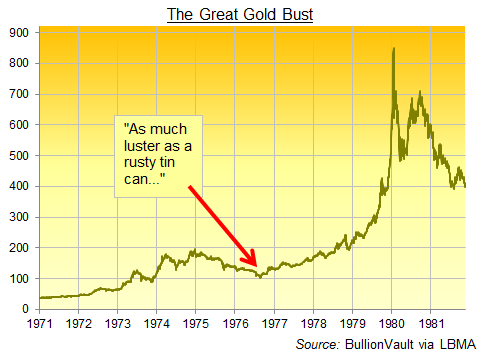

Great Gold Bust of 1976

Similarly, I think, to most gold bulls, I had believed that gold's 2007-2008 34% pullback (from $1034 to $681) had constituted the long-predicted "primary correction" (a substantial but time-limited price decline that is exhibited by most bull markets). However, as I have just stated, gold, in a bull market, can do anything it wants. Over the past 28 months, it has provided a distinctive opportunity to its most consistent friends (the majority of them in Asia) to buy more at up to 40% lower prices. Hey... good deal for those of us who are still buying (and yes, I am one of those). 


So, where are we now? I have commented many times that short-term predictions are "usually wrong." However, I shall attempt one. There are several good reasons to believe that the primary correction of the present gold bull market has been completed. That doesn't necessarily mean that fireworks lie immediately ahead - a strong advance from here might be "too obvious." But are we again climbing the proverbial wall of worry - and to new highs beyond $1924? I certainly think so. 

I commented in the middle of last year (July 2013) that when the gold price has "gone down more" and "gone down longer," it has consistently "gone up more" and "gone up longer." That would certainly imply prices exceeding the $2000 range in the not-too-distant future - that is, over the next 2-3 years, or possibly less. And a decisive break above the September 2011 high would imply an intermediate top equal in magnitude to the previous decline - that is, in the $2700 range. Interestingly, that price point, in turn, would be about halfway to the $5000-6000 level that we have been discussing here for many years, with the wild card of inflation thrown in to make real numbers unpredictable. 


Well, I've got time to relax, to sit back, and simply to observe - and wait. Why not? The fundamentals for the gold price are stronger now than they have ever been, and physical demand for gold is already at dramatic new highs. I don't know about you, but I can see which way this one is going. 

(Artwork by Brenda Brolly.)
_

Monday, July 22, 2013

Did the Zimmerman-Martin Case Just Leave Us with Two More Scapegoats - and an Unchanged System - Rather Than Useful Answers?

14 & 22 July 2013

I have done a quick scan of Google, looking for an intelligent analysis of the Zimmerman-Martin case, the obsessive media coverage of which I acknowledge I have not followed particularly closely. Thus, I wanted to get myself better informed. Unfortunately, a media review has not helped on that count!

So far, all I have found is arguments for one side or the other. In my view, that is simply not journalism, it is advocacy. Thus, I shall here attempt to raise the questions to which I have wanted answers….

In brief, there remains much that is not known, and it certainly raises reasonable doubt in my mind as to whether Mr. Zimmerman committed murder or manslaughter. Issue number one, why did Mr. Zimmerman pursue Mr. Martin when the 911 operator told him not to? Perhaps he assumed that 911 would not get anyone there in a timely manner. Hmmm. He may certainly have been right about that one.

Should Mr. Zimmerman have pursued Mr. Martin? Well, I think it is obvious that he was unwise to do so, for many reasons, the most prominent of which is the fact that Mr. Martin was walking down the street not breaking any laws. My impression is that Mr. Zimmerman was in fear of Mr. Martin from the outset because (1) there had been break-ins in the neighbourhood, and (2) Mr. Zimmerman was already frightened and suspicious of black men.

Was Mr. Zimmerman breaking any laws by pursuing Mr. Martin? In Canada, he would have been breaking several. However, as a neighbourhood watchman in Florida, my understanding is that he was entitled to observe and approach anyone of whom he was suspicious, whether for good reason or not. As our airports are teaching us, in our fearful era, the observation of suspicious behaviour is NOT a requirement for the initiation of monitoring activity.

Was Mr. Zimmerman harassing Mr. Martin? I'd guess the answer to that big question is probably yes, and that he may also have had inappropriate courage due to carrying a gun (legal in Florida).

What options did Mr. Martin then have? Well, he had a neighbourhood watchman following him with a gun (of which he was presumably unaware; I don't know at what point, if any, the gun was visibly displayed). Mr. Martin may or may not have been alert to the fact that Mr. Zimmerman had some level of authority to monitor his behaviour, whether he was profiling him or not. Did Mr. Zimmerman appropriately inform Mr. Martin of his duties, or did he inappropriately provoke Mr. Martin? Again, I haven't followed the story in detail. Maybe this question has been answered, but in my review so far, my impression is that this is unknown. Here, I can imagine a dozen scenarios, in some of which Mr. Zimmerman is aggressive and intrusive, in some of which Mr. Martin is provocative and threatening, and in some of which, both players are getting out of line. Until I know more, my assumption is that the third option most likely applies – that is, that both gentlemen were behaving badly, which in my mind is one of the key conundrums of the case (not the only one, by any means). Was one player more out of line than the other? That is where reasonable doubts (not to mention perceptions and prejudices of many kinds) really begin to surface.

Based on the evidence I am aware of, it is apparent that these two apparently angry young males got into a physical dispute with each other. Mr. Martin seems to have been young, fit, and willing to go at it with Mr. Zimmerman, possibly to the point of making serious threats, if one is to lend credence to Mr. Zimmerman's report of events. Mr. Zimmerman, for his part, was probably behaving provocatively, though, as noted, he was in a position of some authority, whether equipped with the skills to carry out that authority or not. Mr. Zimmerman has been described as unfit and unskilled in physical combat. This all fits with Mr. Martin being "on top of" and physically "close to" Mr. Zimmerman, a point on which the prosecution seems ultimately to have agreed with the defense.

Now, here's where I'm going to draw on personal experience. In my work, I have heard (and sometimes examined) thousands of narratives of physical altercations between disputing parties. The story is ALWAYS different between the two sides. If Mr. Martin was "on top" and Mr. Zimmerman was "on the bottom," who was crying for help? Well, it could have been either one, of course, but, given the circumstances, I'm going to say that the cry was far more likely that of Mr. Zimmerman (Mr. Martin would have felt out of place in a mostly non-black neighbourhood, and thus would not have been likely to perceive help as being available to him, a probable reason for his acting aggressively, which he seems almost certainly to have done).

Would Mr. Martin have used threats – including threats of death, as Mr. Zimmerman reported – to intimidate and deter Mr. Zimmerman? Based on my experience of such encounters, I would say this again is highly likely. Going further out the same speculative limb, I'm going to guess that Mr. Zimmerman may have been more provocative at the outset (though it is perhaps possible that he was not – reasonable doubt, again).

In other words, it is transparently obvious that Mr. Zimmerman was fearful of Mr. Martin from the start. In fact, his excessive level of fear from the outset is probably the best reason why he should NOT have pursued Mr. Martin in the first place. That is, if your fear is out of control at the start, emotional intelligence suggests that further action will lead you deeper into the abyss, as quite obviously occurred in this situation.

So, was Mr. Zimmerman in fear for his bodily integrity and life at the time he discharged his gun into Mr. Martin's chest at close range? On this point, I honestly have little doubt. Mr. Zimmerman was excessively fearful at the start – in fact, so fearful that he certainly should not have acted, particularly with his courage apparently dependent on the gun in his possession. Ultimately, Mr. Martin is on top of Mr. Zimmerman, and, by inference, has the physical edge, and very likely the psychological edge. How fearful is Mr. Zimmerman at this point? Well, if Mr. Martin was truly in the superior position and now behaving in a threatening manner in an act of perceived self-defense on his part, Mr. Zimmerman almost certainly feared serious injury or death. Assuming that Mr. Zimmerman had cried for help, obviously no help had readily arrived (I don't know the time frame, but time passes slowly when you're undergoing traumatic stress – and yes, both were experiencing traumatic stress, and roughly equally, in my best guess).

So, given that this is Florida, and both parties were arguably standing their ground, Mr. Zimmerman discharged his firearm into the co-party's chest, ending his life. On this point, I have little doubt that Mr. Zimmerman was in fear for his bodily integrity and of his possibly impending death.

Mr. Martin, for his part, was dealing with a different, and arguably more complex, set of fears, which probably only a minority group member can fully grasp. In short, Mr. Martin almost certainly assumed that he was "on his own" in Mr. Zimmerman's neighbourhood, and that his best chance of deterring his pursuer was to incite fear in him (compliance with authority is risky for minority groups in an unjust society). Given that Mr. Zimmerman's problem seems to have been excessive fear, Mr. Martin's strategy was thus understandable, but ill-chosen (I'm guessing he would have lived that night, had he reassured rather than challenged his pursuer, but it would have been very hard for him to do this, for many reasons, some of which have to do with issues of race, inequality and the multiple levels of prejudice already in place against him, and he was also a not-yet-mature adolescent male).

Returning to the legal matter in question, and in brief, if Mr. Zimmerman was in fear for his physical integrity and/or life, then there is reasonable doubt that he committed homicide. Thus, on the question to the jury, “was Mr. Zimmerman guilty of homicide,” then "not guilty" is almost certainly the only reasonable answer. However, there remain a dozen or more additional questions which this trial did not either ask or answer. Unfortunately, the media coverage seems also to have skated past these questions. Thus, I guess we are on our own if we want to understand these matters better.

So, please let me close by listing just a few of the unasked questions in this case….

This tragedy arose in the context of a legal system in which an untrained neighbourhood watchman, and indeed, any citizen, is entitled to bear arms, and to use them in self-defense. Further, self-defense is the motive assumed under the law (as it should be), unless it cannot be proven that a legitimate case for self-defense existed. Given this system, how can anyone possibly believe that this (and other tragedies) are not inevitable?

Is this not therefore a systemic problem?

If this is actually a systemic problem, how can focusing on, trying in court - and blaming - an individual whose actions cannot be shown to violate any Florida law, resolve any fundamental problems? 

Should not our dialogue focus on developing a better legal code, and ultimately, wiser, safer and more competent citizens, rather than on the search for scapegoats (on which members of the public somewhat arbitrarily choose sides)?

Moving down from the systems level, here are a few practical questions:

Should fearful young men with guns be acting as neighbourhood watchmen? Also, what level of training is necessary for neighbourhood watchmen?

Does the 911 system actually work in situations where a (possible) immediate threat is identified (whether actual or perceived)?

How can we effectively reduce fear and prejudice among the thousands of differing/distinctive groups in our society?

Could improved social skills on both sides have saved lives and prevented violence this particular night? (I think so.) If the answer is "yes," what skills in particular?

What are the social/institutional causes of crime/threat and racial misunderstanding that contributed to the fearfulness of both Mr. Zimmerman and Mr. Martin?

Why is it so difficult to identify and talk objectively about the experiences, thoughts, emotions and behaviour of both parties in this event?

Did anyone, anywhere, accurately capture the stories of either Mr. Zimmerman or Mr. Martin – or even try?

What reforms would be most effective in preventing recurrences of unneeded violence of this type?

Does Mr. Zimmerman have a continuing moral or legal obligation to redress the harms he did to Mr. Martin, his family and society?

Similarly, does society have some obligation to redress harms done to Mr. Zimmerman?

Were both parties ultimately scapegoated for the sake of pursuing partisan agendas on both sides of the issue - in fact, diverting attention from a system of laws and social policies that cannot possibly produce desirable results?

Are there thus many more than two sides to this issue? What are the real competing agendas here?

Could we do better than this both in preventing violence and in administering justice, particularly in situations that are racially charged?

Conclusion

The point I've been trying to make is that this story is not actually about Trayvon Martin OR George Zimmerman. The United States has a system of laws and social norms that guarantees that such tragedies will be repeated. Mr. Zimmerman was correctly found not guilty. There is far too much room for reasonable doubt in circumstances such as occurred in this particular case to proceed to conviction, and it has nothing to do with "stand your ground legislation."

But where else besides Somalia and the Congo are you going to have neighbourhood watchmen legally bearing arms? That's where the problem begins (and ends), in my view. Until the American legal and regulatory framework is changed, this story will continue to be retold again and again.
_

Addendum: The following is a link to the first coherent specifically legal analysis I've seen - brief, focused, and composed by an experienced Florida lawyer: The Embarrassment Of The George Zimmerman Verdict

Now, I'm waiting for public interest in a systems level analysis of this problem to emerge. I hope not to have to wait "forever," but I fear that I will. 
_

Wednesday, July 17, 2013

How Economic Central Planning Fails

17 July 2013

The "Coups de Whiskey" of the 1920s and the 2000s

Was J. M. Keynes the Paul Krugman of his era? He was the first congratulator of the "coup de whiskey."

From Modern Times - The World from the Twenties to the Eighties, by Paul Johnson:

"Domestically and internationally they constantly pumped more credit into the system and whenever the economy showed signs of flagging they increased the dose. The most notorious occasion was in July 1927, when Strong and Norman held a secret meeting of bankers at the Long Island estates of Ogden Mills, the US Treasury Under-Secretary, and Mrs. Ruth Pratt, the Standard Oil heiress. Strong kept Washington in the dark and refused to let even his most senior colleagues attend, he and Norman decided on another burst of inflation and the protests of Schacht and of Charles Rist Deputy-Governor of the Bank of France, were brushed aside.

The New York Fed reduced its rate by a further half percent to 3.5; as Strong put it to Rist, 'I will give a little coup de whiskey to the stock-market' -- and as a result set in motion the last culminating wave of speculation. Adolph Miller, a member of the Federal Reserve Board, subsequently described this decision in Senate testimony as 'the greatest and boldest operation ever undertaken by the Federal Reserve System [which] resulted in one of the most costly errors committed by it or any other banking system in the last seventy-five years…

"The policy appeared to be succeeding. In the second half of the decade, the cheap credit Strong-Normal policy pumped into the world economy perked up trade...This was genuine economic management at last! Keynes described 'the successful management of the dollar by the Federal Reserve Board from 1923-28 as a 'triumph.' Hawtrey's verdict was: 'The American experiment in stabilization from 1922 to 1928 showed that early treatment could check a tendency either to inflation or to depression…The American experiment was a great advance upon the practice of the nineteenth century…Strong's last push, in fact, did little to help the 'real' economy. It fed speculation. Very little of the new credit went through to the mass-consumer…

"Strong's coup de whiskey benefited almost solely the non-wage earners: the last phase of the boom was largely speculative…The 1929 crash exposed in addition the naivety and ignorance of bankers, businessmen, Wall Street experts, and academic economists high and low; it showed they did not understand the system they had been so confidently manipulating. They had tried to substitute their own well-meaning policies for what Adam Smith called 'the invisible hand' of the market and they had wrought disaster. Far from demonstrating, as Keynes and his school later argued -- at the time Keynes failed to predict either the crash or the extent and duration of the Depression -- the dangers of a self-regulating economy, the dégringolade indicated quite the opposite: the risks of ill-informed meddling."


My comments follow:

Fast forward to today. I believe Mr. Bernanke (our current Fed Head) to be a noble individual, in that he is the most honest (and thorough) communicator the Fed has ever had. However, his communications are quite evidently becoming ever more jumbled, with endless backtracking and restating. That is, if Mr. Bernanke can't say anything coherent, it's because the Fed is failing in its (misplaced) mission - which I understand to be economic central planning.

If there is one thing that should NOT be centrally planned, it's an economy. It's very difficult to separate economic freedom from prosperity. And when I talk to all the small business people filling out all their government paperwork, or observe all the investment managers tuning in to the next Fed speech, it's pretty clear that our economy is now much less free than it once was...

For example, the 1950s, when I was growing up, was a quite free era, despite all the misplaced fears about the doomed system of communism, with its core mandate for the central planning of "everything." Surely the advocates of freedom might have recognized that communism would fail - not because of totalitarianism (which has its own contradictions), but because of economic central planning. 

That is, no "cold war" was ever needed. Economic central planning always fails. It's just a waiting game. 

Unfortunately, today's economic central planners are on our side, and inevitably, despite the fact that they are not totalitarians, their agenda will also fail, just as did those of Lenin, Stalin, Mao, Mugabe, Castro, Chavez, the Kim dynasty, John Law, ad infinitum.
_

Saturday, July 13, 2013

An Essay on Retribalization in the Post-Subsistence Age

15 May 2007 (reposted 14 July 2013)

It has now been many decades since
Marshall McLuhan, the Canadian apostle of television-based social change, postulated, among other things, that the “cool” electronic media – at that time represented primarily by television – were exerting a “retribalizing” influence upon post-industrial civil society.


McLuhan’s ideas are complex and often vague, and he addressed issues of far-reaching cultural significance. Additionally, several decades have passed, and the internet has replaced television as the “cool” electronic medium of our era. Nonetheless, broad culturally-related behavioural changes seem to be evident in our population at large, and it may be worthwhile to consider whether the concept of retribalization sheds some light on how our world is changing.

Let us begin by laying down some
fundamental concepts. Modern humans have walked the planet for a scant 200,000 years, and during almost all of that period, our forebears lived a tribal and subsistence-based way of life. About 5000 years ago, the development of agricultural technology enabled the first gathering of peoples into cities, and this era is generally referred to as the rise of civilization, though I prefer the term civil culture, which refers to the cultural developments that occur when humans engage in a trade-based lifestyle in urban centres.

With the rise of civil culture, the influence of tribal culture diminished, and this was particularly true during the interlinked historical eras of imperialism and industrialization.

Until recently, individuals inhabiting civil cultures regarded themselves as unquestionably superior to individuals living within tribal cultures.

A jolting reminder of this smug worldview was afforded me this week when I watched the 51-year-old John Wayne movie,
The Searchers – truly a movie classic (though now strikingly dated) and the original inspiration for Jonathan Lethem's novel, Girl in Landscape, about which I have blogged earlier.

In a “making of” featurette, Natalie Wood conversed with the self-confident narrator, and the two broached the topic of cultural contrasts while discussing the role of the indigenous Navajo people in the making of the film. Without blinking an eye, the two conversants suggested that the Navajo had historically lived a “savage” lifestyle, but had now abandoned this way of life for a peaceful and subsistence-based, and thus still “primitive,” lifestyle.

I could say much more, but what most struck me about this self-satisfied synopsis of recent history from the vantage point of 1956 is the fact that, in my view, the greater change over the subsequent 50 years has not been the continued “advance” of the indigenous peoples (in this case the Navajo), but in fact the retribalization of the dominant culture – and I think that this is an outcome that neither the narrator nor Ms. Wood ever envisioned.

In both the historical and anthropological contexts, we tend to think of tribal lifestyles solely in terms of subsistence, and for the most part, the age of subsistence has passed, at least in the northern hemisphere.

How then can our society have retribalized over the past 50 years?

Interestingly, if Mr. McLuhan is correct, even the making of films, such as The Searchers, might in fact play a role in this process – and this further compounds the irony of my initial observation.

In brief, Mr. McLuhan held that
tribal culture is characterized by ways of life based on interpersonal speech, story-telling, participatory processes, integrating and decentralized social structures, mythic views of the world, village-based lifestyles, and – in particular – tribal identities.

In contrast, the subsequent “mechanical age” was characterized by hierarchical structures, top-down communication, and rule-governed social behavioural structures, creating a way of life that was individualistic, fragmented, nationalistic, centralized, specialized and urbanized.

Perhaps the height of civil culture is represented in the rise of the British Empire in the 19th century. In addition to national pride, this era was characterized by clearly-defined and often exacting social rules and structures, highly-refined and universally-valued basic skill sets (here I would focus in particular on the primacy of literacy and literate communication), and a clearly-delineated and consensually accepted worldview as to the nature of individual and social progress based on rationality and technological mastery of the environment.

How far we have come in our modern era from the consensual views and hierarchically-structured norms of the Victorian Age.

Many of us who are products of the age of text-based literacy have lamented the breathtaking decline in universal literacy that quite clearly characterizes our current era. One need only spend an afternoon in the attic with the correspondence of one's grandparents to observe that literacy in particular has crumbled in response to the onslaught of the age of electronic media.

And this simple observation gives rise to the instinct of curiosity as to what else might be taking place....

If McLuhan is correct, that electronic media reshape our personal and cultural identities, then we have a starting point for thinking about the disorienting global and cultural crosscurrents that typify our fragmented era.

At this point, I would like to present further – though admittedly inchoate evidence – that a very fundamental and correspondingly radical process of change is afoot.
Picasso represented these changes in his introduction of cubism into the world of visual art, and as an exhibit, I present his classic work (a replica of which took its insistent place on the walls of our family’s summer cabin on the James River of Missouri during my childhood), Les Demoiselles D’Avignon.


The shattered perspectives in Picasso’s paintings offer evidence that our ability to perceive the world has somehow become radically disunified, and in an obviously disturbing way. Picasso’s best-known work, Guernica, certainly illustrates this point more profoundly still.
The literary works of the existentialists, emerging in the 19th and early 20th centuries, anticipated similar developments. Here I am thinking of such writers as Sartre, Camus and Dostoevsky, whose novels consumed my attention and interest during my high school years. One cannot read such works without the sense that our personal certainties have become profoundly disrupted by the incomprehensible diversity and disorder of broad human experience.

Ivan Illich, with whom I was fortunate enough to have been invited to spend a weekend almost two decades ago, argued that we should consider returning to a new kind of “subsistence” lifestyle, for the sake not of our economic survival, but of our survival as human beings capable of relationship and collaboration. Illich also shared McLuhan's interest in the human transition from reliance upon oral communication to text-based communication – and beyond that, to electronically-mediated communication (see: ABC: The Alphabetization of the Popular Mind (1988) ISBN 0-86547-291-2).
Can we not easily contrast the profoundly intricate literary accomplishments of Shakespeare with the primitive linguistic formulations that characterize the great mass of entries on blogspot.com, the virtual space that you as my reader and I as the writer of this essay inhabit at the very moment of your reading of this text?

My grandmother told me stories of neighbourly visiting in her early and mid-adult life. Social visiting was highly formalized, and greeting cards – which she collected and shared with me – were exchanged.

Can anyone argue that tribal warfare remains a force against which our sophisticated and technologized military interventions are virtually useless – or that tribalism has unmade the US adventure in Iraq and is rending much of Africa, the Middle East and South Asia as well?

I pass most of the hours of most of my days in conversations with the Ojibway and Cree people of Northwest Ontario. In most cases, the near-ancestors of these individuals lived a classic tribal lifestyle, and a smaller number of my aboriginal clients have been able to describe to me their experiences of subsistence during their own early years, characterized by living in tents, camping at and walking traplines with their parents, and being raised by their extended family as a “non-nuclear” family unit.

I close here following the above potpourri of examples, because I trust that you can afford your own. And I also wish to reflect on what I have learned and observed through my discussions with individuals whose way of life often continues to express the legacy of many millennia of tribal culture.

My work has caused me to become interested in how tribal people think and behave both similarly to and differently than people with European ancestry, and I have grown increasingly curious as to the factors that characterize the thinking of the individuals who have so kindly shared many of their most personal experiences with me.

Please permit me to summarize briefly a few of my observations

For many of my clients, the self is very much a shared as opposed to an individual reality. How others are impacted by every thought and action is not merely an incidental, but a primary concern. This is an example of the workings of a tribally-acquired identity.

Further, the events of the immediate moment and of the present day very often overshadow concerns as to future expectations, aspirations and consequences. This is not a reflection of anomie or of goallessness – far from it – but of the primacy of immediate circumstances, and of one’s high regard for the importance and needs of one’s present companions.

I believe also that for the tribal person, emotional reality tends to supersede the “rational” worldview. "Sense" is not a construct of logical induction or deduction, but of the interplay of the changing and competing emotional realities of those with whom one is engaged in relationship.

The above are meant to be only a few examples, true to Montaigne's spirit in his penning of his original essays as first “attempts” at the formulation of new ideas through their presentation to others in the form of brief texts.

Let me close by clarifying that I do not regard myself as a tribal individual. I am very much a product of the age of literacy and formalism. But I do perceive that I am surrounded by a retribalizing society and I do not denigrate it – rather I seek to understand it.

Many of the modalities of living that typify the world in which I was raised are literally evaporating before my eyes, and I wish to understand how and why that is occurring, and what it means. The concept of retribalization in the post-industrial era seems to me to be the key to reaching that understanding, though I am only in the early stages of doing so.

Let me close by urging the reader to take some time to watch the classic movie, The Searchers, and don't skip the “making-of” featurettes.

Consider the irony that as Ms. Wood and the narrator converse easily from a perspective of their own presumed superiority, their children and their children’s children have probably become much more similar to the tribal people whom they clearly regarded – only 50 years ago – as less-advanced than themselves.

The children and the grandchildren of the worthy Navajo people who aided in making the film have probably changed much less than have the descendants of the film-makers.

It seems to me that it is now the indigenous peoples of the world who must teach most of the rest of us about how to be tribal, rather than we who must teach them about how to be “civilized.”

It is perhaps only those who still remember the tribal ways who possess the capacity to lead us along the path that we are now following. Further, and perhaps radically, I suspect that human survival itself may depend upon the formation and nurturing of such seemingly inverted teaching and learning relationships.

_

Sunday, January 20, 2013

A Better Idea Than the Trillion Dollar Coin

11 & 20 January 2013

Perhaps you have heard the recent discussion about printing a trillion dollar platinum coin to pay off debts incurred by the United States government. Paul Krugman and a cohort of others are promoting the idea, which has been well-covered by Business Insider: click here. The US Treasury Secretary may be permitted to do this by law, and it's a way to get around the anticipated and potentially rancorous debt ceiling debate.

(James Grant is the one who has perhaps best explained why the trillion dollar coin is not as great an idea as Paul Krugman thinks it is: click here.)

However, there was discussion on Bill Fleckenstein's subscriber website today about an arguably much better, though equally ludicrous idea.


As all major world governments are now essentially just printing money to cover their excessive expenditures, and the US central bank specifically is printing new dollars to purchase government treasuries, a reader pointed out that the same central bank which is purchasing essentially worthless government bonds could legally print inherently worthless money to purchase inherently valuable gold, so as to increase the store of real assets in that country's treasury.

As Mr. Fleckenstein pointed out, any central bank that wishes to could proceed to do this now, until the same currency markets which tolerate moneyprinting (which is usually done for the politically expedient purpose of purchasing government bonds) would (ultimately) be forced to reply, "Hey, you can't do this anymore!"

At this final point, presumably, the central bank which had purchased the most gold with newly printed unbacked currency would be the "winner."

On a related and timely note, James Buchanan, who, like Paul Krugman, won the Nobel Memorial Prize for Economics, died Wednesday at age 93. Mr. Buchanan helped to found the field of public-choice theory, which examines how bureaucracies and elected leaders make decisions.


In 1962, with co-author Gordon Tullock, Mr. Buchanan published "The Calculus of Consent," which challenged the idea of government as a force for good. Experience showed, Mr. Buchanan later said, that "government did not behave benevolently." Rather, "Bureaucracies expanded exponentially" and "the welfare state itself created more demands than it satisfied."

One could argue that Mr. Buchanan "got out just in time!" However, those of us who truly care about our economic wellbeing will miss his presence among us.

13 January 2013: On a related note, the US Treasury Department has ruled out minting the trillion dollar coin. My comments are attached to the linked article: click here. (The Federal Reserve has not announced a decision to print dollars to buy gold, by the way. More's the pity - for the US Treasury.)


My guess, before this decade is out, some country somewhere will in fact decide to print money for the express purpose of buying gold - and will continue brazenly to do so, so long as this practice is allowed by the international marketplace.


Note that a number of nations, with Russia perhaps the most notable among them, have been buying gold aggressively. Russian gold reserves have doubled in the past five years. Russia is also expanding its money supply by 14-22% per year, according to figures published by the Russian Central Bank. (I haven't crunched the numbers, but China is also both printing money and buying gold on a large scale.)


In Russia's case, therefore, the printing of money to buy gold is already occurring on a de facto basis. Is it time for other nations to start playing this game? I think so, though of course, long-term, it is a policy which illustrates more clearly than any other the bankruptcy of the world monetary system.


20 January 2013: I am sorry, I cannot top Mark Steyn on the trillion dollar coin, so I'm linking to his scintillating and timely opinion piece: click here

You've gotta read: 

_

Friday, January 11, 2013

Last Friday Might Have Been the Start of the Next Rise in the Gold Price

11 January 2013, 14 July 2013

I have mostly stopped commenting on the gold bull market, as the widespread adoption of inflationary monetary policy by every major government on the planet has all but guaranteed a continued rise in the gold price. However, last Friday (January 4, 2013) may possibly have been the day that the most recent gold price decline came to an end, due to the technically meaningful and usually decisive "bull hammer bottom" technical signal that day (this type of bottom usually confirms an exhaustion of selling pressure).


My current thoughts follow. The use of the capital letters "A" through "D" refers to the theoretical model of gold price advances and declines put forward by Mary Ann and Pamela Aden. That is, "A" is a modest gold price rice (the last one occurred between December 2011 and October 2012), "B" is a modest decline (we have been in a B decline since early October 2012), "C" is a massive and extended gold price rise running for a year or longer (the last one extended from May 2009 through September 2011 - over 2 years), and "D" is a sharp and decisive (though temporary) downturn in the gold price, with the last one having occurred between September and December 2011.

Nobody I know of can predict "when," but the directionality of the gold price has been clearly upwards since December 2011 (D bottom). The current (C) rise appears only to have started last Friday, January 4, 2013 (the probable conclusion of the "B decline"), so it is "young." 


Friday, January 4, 2013 looks like the "bull hammer" bottom, which appeared decisive. However, since this is (probably) the C rise now, it can run 1-1/2 to 2-1/2 years. What we're waiting for now is for the mainstream analysts to stop saying, "Oh, gold topped out in September 2011, it's done now." (Before that, it had supposedly topped out in 2006, 2008 and 2009, not to mention 2003 and 2004). 


The way you know that gold is nearing a top is when the people you meet on the street are buying (and talking about) gold investments - just as they did with tech stocks in the 90s, and with real estate investments this decade. That has not really started, though you do now have little stores selling gold as well as "taking it off your hands." There is also gold advertising on television now. 

Following this "last" very big pullback, the final blowout bubble top in gold would finally occur. By the Adens' charting system, 2019 would be the true top of the secular gold bull market - if it is typical, and it would be somewhere north of $5000 by then, probably $8000 or higher. This is all approximate. 


It is also possible that gold could go into an extended secular mega-bull market, as bonds have done for the past 30 years.That is, most bull markets seem to run 17-18 years (so 2001-2019 would be a "standard" 18-year gold bull market, as was the case from 1962-1980). 


But mega bulls are almost twice that duration. The duration of the gold bull market, of course, depends on fiscal policy. 

So long as governments print trillions per year in new and worthless currency, we know that gold will rise (nothing else is possible). When that stops, the gold bull market will be over. 


However, I'm not sure that moneyprinting and competitive currency devaluation by most major world governments will necessarily stop in 2019. Note that bonds have been in a 3-decade-plus uptrend since 1981-82 (the end of the last major inflationary period). If gold is in a mega bull market, it could rise through 2030 or longer, before massive global inflationary monetary policy would ultimately defeat itself.


So, hang on until 2019 at least (be careful in 2016), and keep your eyes on 2030 if governments are still printing away by the end of this (still young) decade. 


14 July 2013: But it wasn't....

Well, my last few predictions on the price of gold have been dramatically wrong. Despite arguably the strongest fundamentals in history, gold has managed to plummet while essentially all the factors that normally tend to lift the price of gold have been advancing steadily. I've been watching the gold market for a decade now. What have I learned? In brief, when the fundamentals are bullish, the following two rules have so far applied: (1) When the price of gold goes down more, it then goes up more. (2) When the price of gold goes down longer, it then goes up longer. Stay tuned for $5000 gold, and higher. When? Don't ask me. I don't know. But nothing has happened to alter my prediction. 
_

Saturday, December 15, 2012

The Deflation Trade Is Over

13 September & 15 December 2012


(This article was originally published on September 13, 2012.)

Ben Bernanke announced unlimited moneyprinting at 12:30 PM EDT today.

Joe Weisenthal has called it a "game changer." He is correct. Click here for the key text from the Fed statement and for Mr. Weisenthal's quick take.

What does it mean that the deflation trade is over?

There is no longer any cap on US moneyprinting. Further, the Eurozone has also committed itself to a moneyprinting-based strategy. Inflation will prevail. Long-term interest rates will rise (despite the massive demand-boost of Federal Reserve long-term securities purchases of $85 billion per month - a trillion dollars per year!).


Gold investors have rounded Cape Horn. For the past 6 years, deflation fears have created vicious headwinds for the precious metals sector, and destroyed the market value of gold and silver miners, explorers and mine developers. As of today, that has changed, for all practical purposes, permanently.

To switch analogies for a moment, this is the gold tsunami. It is now unstoppable. Gold will just rise and rise and rise as central banks and governments everywhere shred their currencies to make continued spending and debt repayment possible.

I could write pages and pages on this topic, but consider this the executive summary.

I may not have much more to say about the gold market after today. Clear sailing on smooth seas under a sunny sky with a steady tailwind isn't headline news. It is just a forecast for fair weather for years to come for gold, silver and precious metal mining investors.

We aren't there yet, but we are on a steady course, sailing under ideal conditions.


Interestingly, most investors are not positioned for the best of all possible worlds for precious metals. If you are not, you had better get there.

Gold has been the best-performing investment of the past decade. Looks like we've got another decade to go!

The chart below shows the ratio of the Canadian TSX Venture Exchange Index (CDNX) to Gold (priced in US dollars). The CDNX is dominated by precious metal explorers and early-stage mine developers. It was destroyed relative to the value of its underlying assets (gold and silver) by the deflation-scare and collapse of 2007-2009, and remains at its lowest-ever relative levels today (it fell to its all-time low of .7203 only on August 31, 2012 - that level will never be seen again). Note that if this ratio returns to its historic (pre-2007) range of 2.8-5.14, that would represent an appreciation of the market value of this index of 278% to 559%. With the deflation scare probably permanently over, that is perhaps not an unrealistic expectation. Think about it.


Enough said?

* 15 December 2012: OK. Just to wrap up the deal. Operation Twist (the sale of short-term US monetary instruments to purchase long-dated US bonds at a pace of $45 billion per month) expires at the end of 2012. Mr. Bernanke announced on December 12, 2012 that the Fed will now make outright US bond purchases without clearing its balance sheet. These are known as "unsterilized" transactions, yet another euphemism for outright moneyprinting. Again, no end date was announced. The program may be discontinued when inflation is measured above the 2.5% annual level (it is, of course, far above that level now, but if you value a $249 computer in the thousands and count ground beef as equivalent to steak, as well as discounting food and energy costs as "variable," it is possible to produce inflation numbers below 2.5%, as the Federal Reserve has done), or if unemployment falls below 6.5% (how do you want to measure that, as similar problems in calculation emerge here as well?). 

So, in brief, we are promised low (short-term) interest rates for years to come, to encourage borrowing and debt accumulation (why is this a good idea?), and the Fed has promised to print $85 billion in new US dollars monthly (even this won't cover the massive Federal deficit!), or $1.02 trillion annually. At these levels, the US dollar money supply will continue to grow at a pace roughly equivalent to the US dollar debt position. As I said in this article, there is nothing more to be said about gold investing. I published a couple of notes after September 13, 2012, but yes, I am done commenting here on the gold market. 

Gold can ONLY rise in this environment, though, since it is traded on the open market, its price will vary from day to day and month to month. But yes, the US dollar is being destroyed, the US Federal debt will never be repaid (except in grossly inflated dollars), and every major world economy is hell bent on inflation or "moneyprinting" (even those with stringent austerity programs). So yes, I am done commenting on this topic. 

Buy yourself some gold and hold on to it. It will preserve value, at minimum, and, due to being neglected for decades and also to being a minuscule market on a global scale, gold will probably outperform most other investments as demand continues to accumulate. I hope my articles have been helpful. Honestly, there is simply nothing more to say on the topic except, "Buy gold,  gold and silver miners, gold and silver royalty companies and emerging producers, hold on, and bide your time. Your patience will be amply rewarded."


OK. Let's update one factoid. The CDNX:GOLD ratio has fallen further than its prior August 31, 2012 all-time low of .7203 (cited above). It reached a new and recent low of .6864 on December 13, 2012. Is that newer, lower ratio the all-time low? Well, the small-cap sector is now under such deep pressure that the market presupposes many of these planned mining projects will never go forward. If this sentiment continues, the CDNX:GOLD ratio could drop further still. However, don't bank on it. Interest rates are still low, and banks are again swimming in liquidity. Somebody, somewhere will fund these operations at today's drastic discounts, as gold and silver prices continue to climb. The small caps are by far the cheapest way to buy gold and silver in the ground. At some point (not today and not tomorrow), these projects will be snapped up and taken out of the sights of mainstream investors. 


If you can tolerate the pain, a small to moderate percentage of your investment portfolio could continue to be maintained in promising small cap gold and silver explorers and mine developers. There are names in this sector which are likely to do well in almost any conceivable circumstances - ATAC Resources (ATC.V) being only one of many!
_

Monday, November 19, 2012

Arizona I-40 Navajo County Traffic Scam

Just a warning to tourists travelling on Interstate 40 in Navajo County in Arizona.

You've heard of the rattlesnakes, scorpions and cactus in Arizona. In Navajo County, the poisonous creatures wear uniforms.


My impression is that police officers in this area are running a scam operation. Driving legally will be of no benefit to you. I was pulled over on an allegation of failing to signal a lane change, though in fact I did signal the change.

The officers then seek out opportunities to place more serious and sometimes bizarrely trumped up charges against their unwitting victims. Take caution.

Here is an overview from Griffen & Stevens Law Firm PLLC (click here):

"Police officers across northern Arizona, including Flagstaff and Holbrook, are initiating traffic stops on unsuspecting drivers, usually those traveling west from California (sic), for bogus reasons like: GPS device on windshield, unsafe following distance, illegal lane usage, speeding 1 or 2 mph over the limit, and endless other pretexts for pulling someone over. Then the officers can ask a driver to get out of their vehicle, wait by the police car while the officer issues a “warning” and begins interrogating that person about drugs and other illegal activity. The officer tries to look for indicia of criminal activity and drug trafficking, and will often utilize a drug detection dog. Ultimately, the officer wants to pressure you to consent to a search of your vehicle."

Again: Legal behaviour is no defense. These licensed predators are in my opinion running a scam operation. If you drive legally in Navajo County, you could be their next victim.

My advice. Don't drive Arizona Interstate 40 in Navajo County - period. Stay away. I for one will not be back (and I'll be spending much less time - and tourist dollars - in Arizona in future).
_