Friday, November 22, 2019

Russia's "Can't Lose" Financial Strategy

17 February 2014 - updated 22 August & 22 December 2014; 30 January 2015; 21 April 2015; 2 January; 20 September 2016; 22 March & 29 July 2018; & 22 November 2019

This is a legacy article, dating back to February 2014. I have been adding updates as they come available. Russian gold reserves have more than doubled since I first published this article, and now stand at fifth in the world. 

Here's a strategy I've thought about for a while now. This is only possible because we have abandoned the gold standard (and with it, sound money - you can talk to Ben Bernanke, Janet Yellen and Jay Powell about that --- in fact, to any central bank president almost anywhere in the world --- they are all doing the same thing!). 


Let's just say a government decided to print money out of thin air and use it to buy gold. You start with something that is an entirely artificial construct (any national currency in today's world meets this criterion) and use it to buy something that is real, scarce and irreplaceable (gold still meets THOSE criteria!). Voila! You have a "can't-lose" strategy for getting leaps and bounds ahead of everyone else. 

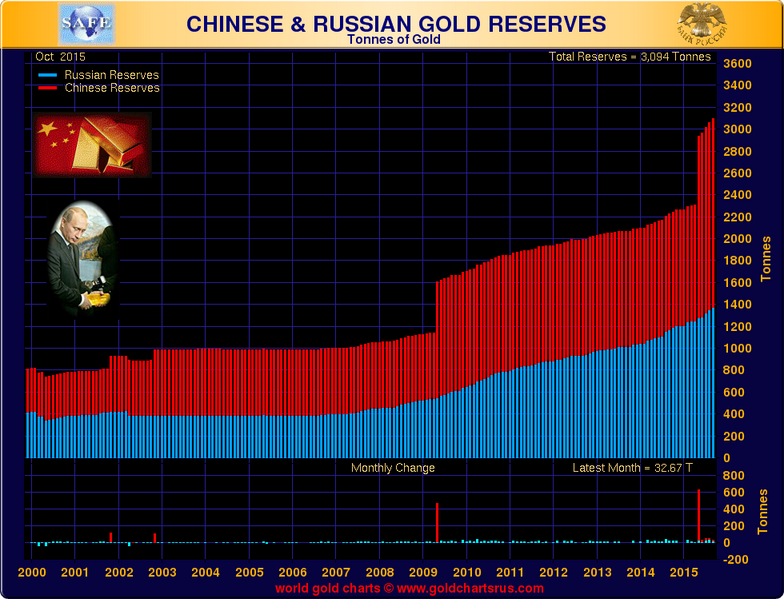
And... at least one country is actually doing this. Check out these two Russian charts.... 


(1) They are buying-up gold hand over fist; and 


(2) They are printing money like crazy out of thin air to pay for it (it's virtually without cost for any nation to increase their "money supply" in the same way, but very few are taking advantage of the continuing --- and surprising --- legality of doing this!). 


Vladimir Putin is a smart guy, period. Perhaps a few of the rest of us should clue in... and catch up. If only individuals were  allowed to  print their own currencies,  as nation-states do! 

Russia's gold reserves were up 150% in 7 years when I first posted this article:


At the same time, Russia's money supply had increased fully by 33% in only 2 years: more than that of the US, Europe, Japan or China at the time. 


Today, in November 2019, Russia's gold holdings are 650% higher than they had been in 2006 (before the bursting of the most recent global financial bubble). 


I had argued at  the time that rather than bailing out Wall Street and the US government, the Federal Reserve should have just put $10,000 in the mailbox of every US citizen (yes, they actually spent more than that much "new" money to rescue the still-staggering US economy and business elites). This would have done MUCH more for the Main Street economy than bailing out BOTH political parties, GM, Countrywide Financial, Bank of America, AIG Insurance and many other monied interests....

But a better scheme even that that would have been to take the $4 trillion new dollars they had printed to bail out the government and the banks after 2008, and to have quietly, discreetly, and persistently bought gold with it. 


Ben Bernanke gave all his money to companies such as Citibank, Fannie Mae, General Motors, and (primarily) the US Treasury, which spent it faster than it came in. It was gone as fast as it was printed, and very little of it actually added to national economic growth.  


By way of contrast, Vlad Putin bought gold with his "printed money." That gold is worth much more now than when he bought it, and, keep in mind, he bought it just by rolling his monetary printing presses! In my world, Mr. Putin is BY FAR the wiser --- and smarter --- man.

_

22 August 2014: While some reports show slow periods and even temporary reversals in Russia's accumulation of gold, the most recent figures from the World Gold Council show that Russia has (again) reported an increase in its official reserves since February 2014, moving its place in global national gold rankings up two additional slots. What can I say? Print money, buy gold. It's legal. Just what I don't really get is why only the Russians are doing it.... (Believe me, some day, this will no longer be allowed!)


Russia (#5 globally):
Official gold holdings:
1,094.7 tonnes

Percent of foreign reserves in gold:
9.7%

Russia has increased its gold holding since February 2014 and has eclipsed both Switzerland and China. In August 2014, Russia's central bank decided to buy up even more gold and diversify away from the dollar and the euro as a result of economic sanctions imposed by the West.

Russia's central bank gold holdings crossed the 1,000-tonne mark for the first time in Q3 2013.

Source: World Gold Council

22 December 2014: While I disagree with Mr. Putin on many points, in particular, the suppression of diversity and political and economic freedom at home, the Russians continue to be cleverer than we in many other respects. Despite rumours that they have been selling gold, in fact, it is US dollars that they have been unloading, while (wisely) buying ever more gold.


For more information, click here.

30 January 2015: Russia's gold purchases were up 123% during the first 11 months of 2014, including the period during which the Ruble began to collapse. The Financial Times reports:

"Russia’s central bank purchased 152 tonnes of gold worth $6.1bn at today’s prices, according to GFMS estimates. Analysts also said Russia’s purchases might have been due to the buying of domestically produced gold that could not be easily sold overseas due to sanctions.

“'This is a clear positive for the gold price,' said Matthew Turner, analyst at Macquarie. 'If central banks had not purchased that gold it would have been bought by private investors or jewellery consumers, and this would likely have required a lower gold price.'

"While Russia was a strong buyer this year, analysts say purchases could slow and the country could become a seller if it continues to liquidate its reserves to support the domestic currency."

For the full story, click here.

21 April 2015: Kitco News reports that Russia has resumed gold buying following a 2-month hiatus (click here):

"After a two-month hiatus the Central Bank of the Russian Federation jump back into the gold market, demonstrating that official demand remains strong, say analysts.

"According to media reports, the Russian central bank bought 28 tonnes of gold in March, the biggest one-month purchase since September. In January the central bank sold 0.5 tonnes of gold and didn’t purchase anything in February.

"The report noted, as of April 1, Russia’s official gold reserves stood at 1,128.3 tonnes, compared to the previous level of 1,207.7 tonnes. According to data from the World Gold Council, Russia has the fifth largest gold reserves in the world (not including reserves held by the International Monetary Fund).

2 January 2016, The world's smartest gold buyers have done it again. As of November 2015, we have these figures:

- Russia adds another 700,000 ounces (22 tonnes) to gold reserves in November
- Russian ally Kazakhstan increased gold reserves for 38th month – 7 Mil ounces
- Russia has added 197.1 tonnes in 2015 – Compared with 172 tonnes in all 2014
- November gold buying is Russia’s ninth straight month of increase
- Russia now has sixth largest gold reserves in the world
- Central bank buys all Russian gold production
- Other Russian gold demand imported
- Russia views gold bullion as “100% guarantee from legal and political risks”

RussiaReservesst20151219

Russia continues to add to its gold reserves and added another 700,000 ounces in November or another 22 metric tonnes, and analysts believe this buying will continue and may intensify in the coming months.
Russian ally Kazakhstan increased its gold reserves for a 38th month to 7.03 million ounces in November from 6.96 million ounces a month earlier.
The latest large increase in Russia’s gold reserves – a “buying spree” as reported on Reuters Africa has again gone largely unnoticed by most analysts. Indeed, the important monetary and geopolitical ramifications continue to be largely ignored in western media.
Russia’s total gold reserves have now increased to 44.8 million ounces or around 1,392.8 metric tonnes (up 40% from February 2014, when this article was originally published), with a current value of just $48.3 billion. Russia’s total FX reserves are $371.2 billion and their gold allocation remains just 13% of their total reserves.
The share of gold in Russian foreign exchange reserves is much lower than in many other countries such as the U.S., Italy and France. Russian diversification into gold is likely to continue and could intensify if relations with the U.S. and NATO powers further deteriorate.
Russia still has less than a fifth of the gold reserves of the U.S. which are believed to be over 8,400 metric tonnes of gold. However, the U.S. has no foreign exchange reserves and is the largest debtor in the world – indeed it is one of the largest debtors the world has ever seen.
Russia now has the sixth highest gold reserves in the world – behind the U.S., Germany, Italy, France and China.
In 2014, Russia bought more gold in than in any year since the break-up of the Soviet Union. The country acquired over 173 metric tonnes according to World Gold Council figures. Reserve diversification intensified after April — averaging about 20 tonnes per month....
Click here for the full story from GoldCore....

Meanwhile, Russian money supply has grown another 7% since the end of 2014, an increase of about 2.2 trillion roubles. 
As I've been commenting, why not print money and buy gold with it? The Russians have got it figured out.... 20 September 2016. The Russians have outdone themselves again. Russia, which has defaulted 5 times and has been in that state for 10 of the last 26 years, just sold a stack of bonds to a collection of hedge funds, pensions and "smart" buyers. Some if not all the proceeds at the government level apparently went to buy yet another 700,000 ounces (21.77 metric tons) of gold in a single month! The Russians are truly unequaled at the level of long-term financial strategy. Click here for more information. 

There is more information here, regarding Russia's fast-rising store of gold. 

Clearly the Russians know something we don't!

22 March 2018. When bars of gold came flying out of a cargo plane taking off from a Siberian airport earlier this month, littering the run-way with precious metal, it was more than symbolic: Russia is hoarding gold, and it’s apparently got so much it can’t keep it contained.

Russia’s been hoarding gold for a while—but it’s going for a new record in 2018, dumping U.S. treasuries for gold at a rate not seen in years as it overtakes China for fifth place among the world’s sovereign holders of the precious metal....
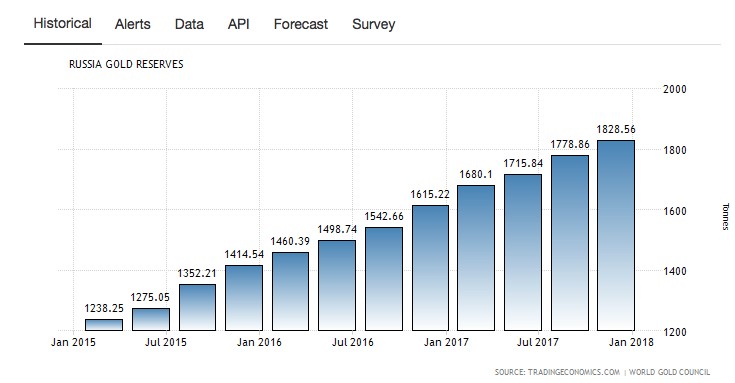


29 July 2018. Russia added 500,000 ounces of gold (15.55174 tons) to reserves in June and bought some 106 tons of gold since the start of the year, with total reserves now approaching the 2,000-metric-ton mark. Last year, Russia added a record 224 tons of gold to the reserves. 

Image result for russian gold holdings chart 2018

Notably, the Bank of Russia has been buying gold every month since March 2015, overtaking China as the fifth-largest sovereign holder of gold. Russia‘s U.S. dollar reserves have also shrunk from $96.1 billion in March to just $14.9 billion in May, according to the Russian Central Bank. Its governor, Elvira Nabiullina, says the decision will help protect the Russian economy and diversify the bank’s reserves.

It's striking that while other central banks have gotten rid of gold and accumulated US dollars, the Russians have been far smarter, getting rid of US dollars and accumulating gold. 


22 November 2019. The Russians are beating the western nations at strategy at every turn. Russia added 9.3 metric tonnes of gold to its official reserve position in October. Gold is now 22% of official reserves. The country's total gold reserve is now 2,252 metric tonnes, much less than the U.S., but twice as much as the U.S. holds on a gold-to-GDP basis. Yes, America holds the world's largest store of gold, but that is because of responsible past leadership. The Russians and the Chinese are living in the present, and alert to what is going on now.


Further to Russia's advantage, the US dollar gold price has doubled since 2006. 


Buy gold for free, and multiply times two! 
_

Thursday, February 21, 2019

Dow Crash Reaches Second Decade - in Gold Terms

21 February 2008, Updated 21 & 23 February 2009 and 21 February 2019

I originally posted this article eleven years ago, on February 21, 2008. It has not been rewritten for contemporary circumstances. Rather, I would like the article to stand as a testament to my 2008 viewpoint on the investment markets. The following text is unedited from 2008:

I am reposting this piece as the theme remains timely. The Dow crash in gold terms will complete its first decade in August of this year. What then? In my view, the second decade of the "real Dow crash" will then begin. Read on for more information. Or, if you recall reading this last year, my updated analysis is at the end of this article. The text below was composed on February 21, 2008:

There has always been speculation as to whether the venerable Dow-Jones Industrial Average will crash in response to one economic event or another. The crisis of the day tends to spark renewed interest in this topic, including various analogies to the great crash of 1929. Of course, today's crisis is the subprime meltdown and the spurious lending and securitization practices that underlie it. Will the present financial and real estate bubble cause the Dow to crash again?


Today's post is intended to keep questions such as this in perspective.

When you measure the Dow in terms of real money (gold), it in fact reached its peak in August 1999, and has declined steadily since that time. In late August 1999, one unit of the Dow Industrials would have cost you 44.84 ounces of gold. That of course would not have been a good buy if you were then a holder of gold (though Gordon Brown, then Chancellor of the Exchequer for Great Britain, was selling the last of the mighty empire's great store of gold at bargain basement prices at that time; in fact, Mr. Brown sold 60% of Britain's gold at a lowly $275 per ounce between 1999-2002, one of the worst acts of market timing by a government official in recorded history - and government officials are rarely noted for their economic acumen - Ronald Reagan and Margaret Thatcher partially excepted!).

If you had held onto your gold in 1999, and waited until today to buy the Dow, you could have had it more cheaply. At today's prices, roughly 13 ounces of gold will now buy you a unit of the Dow. That is, you get a single Dow unit for 32 fewer ounces of gold, which remains a timeless currency with relatively stable purchasing power. Let's round that off, and call it a 70% discount.

Or, alternatively, let's just say that the crash of the Dow is now in its 9th year, and that it has so far fallen 70% while facing into the headwinds of the mega-inflationary 21st century.

Is the Dow done falling, now that the Dow-to-gold ratio stands at 1:13 vs. almost 1:45 only 8-1/2 short years ago?

Not according to those who engage in long-term analysis.

In fact, the Dow has tended to bottom against the price of gold at roughly a one-to-one ratio every 40-50 years. As Eric Hommelberg's 2005 chart of the Dow-to-Gold ratio shows, you could last have bought a unit of the Dow for the cost of about one ounce of gold in 1980 (when an ounce of gold at $887.50 per ounce was almost as valuable in (nominal) dollar terms as it is today (gold presently stands at about $950 per ounce). Mr. Hommelberg was conservative in 2005, speculating that the Dow might fall to the value of as many as 5 ounces of gold. Three years later, Mr. Hommelberg's projection now appears quite modest.

What are the implications?

If you are more patient (and prescient) than Gordon Brown, and hold onto your gold a bit longer, perhaps another 10-20 years, the chances are that you will be able to buy one unit of the mighty Dow-Jones Industrial Average for a single ounce of gold - possibly less, approximately a 98% discount to the deal that Gordon Brown got for the British government, beginning at the Dow's gold peak in 1999.

Is the Dow, therefore, going to crash again?

I hope you can see now that this is the wrong question.

It already has.

The Dow has so far fallen 70% against the price of gold in the 8-1/2 years since the Dow's August 1999 peak in gold terms, and it is presently just in its next leg down, as today's charts make abundantly clear. (Click here for a current analysis by Captain Hook.)

Chances are, the Dow has another 28% to go before it's done - when a single unit of the Dow-Jones Industrial Average will be of the same value as a single ounce of gold. At that time, the Dow will have collapsed 98% against the price of gold.

I guess you could call that a Dow crash.

21 & 23 February 2009:

Since posting this article one year ago, at which time 13 ounces of gold were required to buy the
Dow-Jones Industrial Average, the trends I identified have if anything accelerated.

In a short year, you now get almost "twice the Dow" for your amount of gold, as the Dow has fallen almost another 50% in gold terms over the past 12 months. 7 ounces of gold will presently buy you the
Dow-Jones Industrial Average, as compared to 44.84 ounces of gold in August 1999, or 13 ounces of gold in February 2008. That is, the Dow:Gold ratio has now slipped by 84%.Want my advice?The Dow is still no bargain. Don't cash in that 7 ounces of gold for the Dow, but hold onto your gold - for further long-term appreciation. This trend has years to run, as the "real Dow crash" completes its first decade. As of August this year, the Dow crash against gold will enter its second decade, and the crash - or collapse, if you prefer - will simply continue.

Gold has much further to rise, and the Dow much further to fall. A unit of the Dow for 7 ounces of gold remains no more a bargain than when 45 - or 13 - ounces of gold were required to purchase the Dow in 1999 or 2008!
Let me emphasize that I am not predicting short-term trends here. The Dow might rise for several months, and gold could fall for several months. I believe short-term market prediction is essentially impossible. But why take the chance? The trend is clear. If you did not exit mainstream equities in 1999, or even in 2008, you can still get out now.

Gold - though volatile in price on a short-term basis - remains a safe and comfortable companion in uncertain economic times. And in our present case - where is the uncertainty? We know that the foundations of the economy are at their most unstable in almost a century - and, as a consequence of leverage and other forms of financial gymnastics - perhaps at their most unstable in all of human history. Gold is the obvious choice in such circumstances.

(See also these related posts, comparing the Dow to the AMEX Gold Bugs (HUI) Index, and exploring the issue of "financial disasters.")


UPDATE FEBRUARY 21, 2019: Here's how the Dow looks in nominal (non-inflation-adjusted) terms. It seems to be doing well, particularly since 2009. However, appearances can be and frequently are deceiving, especially in the investment markets. 


By way of contrast, in gold terms, the Dow Jones Industrial Average has lost 57% of its value since 1999, and that is not adjusted for inflation, which has been quite considerable over the past 20 years, and more than the government is willing to tell you. Using official numbers, you must subtract an additional 34% from your adjusted 1999 investment amount (43% remaining, minus 34% inflation, leaving only 28% of your original investment intact). This calculation yields a (marginal) inflation-adjusted 20-year loss of 72% in gold terms.

Once you take out the inflation, there is just about nothing left, except you do get to keep your dividends. To be clear, dividends are nice to have, but when you have lost 72% of your principle, the dividend is best attributed to "return" of principle (I would say "destruction" of principle). 

Keep in mind that inflation is much higher than the government reports. A rough estimate is that very likely 90% of your principle is already gone, 20 years later (when contrasted to a scenario in which you had purchased gold with your investment funds, rather than the Dow). 


Further, after falling from 2011 to 2015 in US dollar terms, gold has renewed its uptrend since December 2015 (so far modestly, though definitively). Gold's greater than 3-year renewed uptrend implies a return to a downtrend in the Dow on the Dow:Gold ratio chart, quite likely very soon. 


You'll recall that 44 ounces of gold were required to buy the Dow in 1999. That number fell to 13 ounces in 2008. While the Dow has obviously recovered considerably, and is currently at new (all-time record) nominal highs, you can still purchase the Dow for only 19 ounces of gold, yielding the 57% cost saving we discussed earlier. 


Are we again approaching a time when you can buy the Dow for only 1-5 ounces of gold? As we saw above, that happened in the 1930s, and again in the 1970s (and came as close as 7 ounces of gold in 2009). Cycles tend to repeat, and it's virtually certain that this will happen again.

My advice: If you haven't done so already, get out of the stock market now, while your savings are still intact, and maintain a substantial portion of your savings in the precious metal sector (the percentage is up to you, though the standard recommendation of "10%" is insufficient for current circumstances --- I suggest 50% or more as a proportion appropriate to today's highly dangerous bubble conditions in all asset markets). 

And: Click here for a great discussion of this topic: Dow Gold Ratio: How Does Gold Compare to Shares For the Past 100 Years?

_

Tuesday, January 01, 2019

The New Fusion Industry Association Opens the Door to an Accelerated Pace of Fusion Power Development

1 January 2019

The new Fusion Industry Association is mentioned in the article excerpt below. The Fusion Industry Association is a registered non-profit organization composed of private companies working to commercialize fusion power. The Association advocates for policies that would accelerate the race to fusion energy. From the Massachusetts Institute of Technology (MIT) Plasma Science and Fusion Center (click here):


Image result for Fusion Industry Association

A new report on the development of fusion as an energy source, written at the request of the U.S. Secretary of Energy, proposes adoption of a national fusion strategy that closely aligns with the course charted in recent years by MIT’s Plasma Science and Fusion Center (PSFC) and privately funded Commonwealth Fusion Systems (CFS), a recent MIT spinout.


Fusion technology has long held the promise of producing safe, abundant, carbon-free electricity, while struggling to overcome the daunting challenges of creating and harnessing fusion reactions to produce net energy gain. But the Consensus Study Report from the National Academies of Science, Engineering, and Medicine states that magnetic-confinement fusion technology (an MIT focus since the 1970s) is now “sufficiently advanced to propose a path to demonstrate fusion generated energy within the next several decades.”

It recommends continued U.S. participation in the international ITER fusion facility project and “a national program of accompanying research and technology leading to the construction of a compact pilot plant that produces electricity from fusion at the lowest possible capital cost.”


That approach (which the report says would require up to $200 million in additional annual funding for several decades) leverages opportunities presented by new-generation superconducting magnets, reactor materials, simulators, and other relevant technologies. Of particular emphasis from the committee is the advances in high-temperature superconducting magnets which can access higher fields and smaller machines. The report recommends a U.S. program to prove out high-field large-bore magnets. They are seen as enabling faster and less-costly cycles of learning and development than extremely large experiments like ITER, which will not come on line until 2025, while still benefitting from the knowledge that emerges from those programs.

This smaller-faster-cheaper approach is embodied in the SPARC reactor concept, which was developed at the PSFC and forms the foundation of CFS’s aggressive effort to demonstrate energy-gain fusion by the mid-2020s and produce practical reactor designs by the early 2030s. This approach is based on the similar conclusion that high-field high-temperature magnets represent a game-changing technology.

A $30 million program between CFS and MIT to demonstrate the high-field large bore superconducting magnets is underway at MIT and is a key step to a compact fusion energy system. Despite a handful of other privately funded fusion companies having offered roughly comparable (10 to 15-year) timelines, the National Academies report does not envision demonstration fusion reactors appearing until the 2050 time frame (my emphasis).


The report also affirms that the scientific underpinnings of the tokamak approach have been strengthened over the previous decade, giving increasing confidence that this approach, which is the basis of ITER and SPARC, is capable of achieving net energy gain and forming the basis for a power plant. Based on this increased confidence the committee recommends moving forward with technology developments for a pilot power plant that would put power on the grid.

“The National Academies are a very thoughtful organization, and they’re typically very conservative,” says Bob Mumgaard, chief executive officer of CFS. “We’re glad to see them come out with a message that it’s time to move into fusion, and that compact and economical is the way to go. We think development should go faster, but it gives validation to people who want to tackle the challenge and lays out things we can do in the U.S. that will lead toward putting power on the grid.”

Andrew Holland, director of the recently formed Fusion Industry Association and Senior Fellow for Energy and Climate at the American Security Project, notes that the report’s authors were charged with creating “a consensus science report that reflects current pathways, and the current pathway is to build ITER and go through the experimental process there, while meanwhile designing a pilot plant, DEMO.”


Shifting the consensus toward a faster way forward, adds Holland, will require experimental results from companies like CFS. “That’s why it’s notable to have privately funded companies in the U.S. and around the world pursuing the scientific results that will bear this out. And it’s certainly important that this study is aimed at getting the government-based science community to think about a strategic plan. It should be seen as part of a starting gun for the fusion community coming together and organizing its own process.”


Or, as Martin Greenwald, deputy director of the PSFC and a veteran fusion researcher, puts it, “There’s a tendency in our community to argue about a 20-year plan or a 30-year plan, but we don’t want to take our eyes off what we need to do in the next three to five years. We might not have consensus on the long scale, but we need one for what to do now, and that’s been the consistent message since we announced the SPARC project — engaging the broader community and taking the initiative.

“The key thing to us is that if fusion is going to have an impact on climate change, we need answers quickly, we can’t wait until the end of century, and that’s driving the schedule. The private money that’s coming in helps, but public funding should engage with and complement that. Each side has an appropriate role. National labs don’t build power plants, and private companies don’t do basic research.”

The MIT article continues as linked above.

It looks as though I have more research to do. I have identified 21 currently active fusion power development programs (click here), but there may be a few more to explore, via their memberships in the new Fusion Industry Association.... Note that while primarily US companies are represented, the membership of the Fusion Industry Association is already international.

Note: The Fusion Industry Association is also on Twitter (click here).
_

Sunday, December 23, 2018

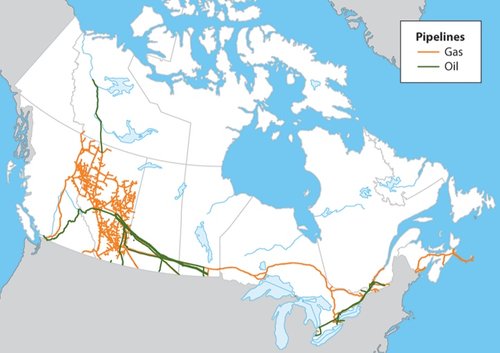
CANADA NEEDS TO DEVELOP ITS OIL AND POST-CARBON TECHNOLOGIES CONCURRENTLY --- OIL IS A TRANSITIONAL TECHNOLOGY

23 December 2018

Carbon emissions rose 3 per cent in 2018 and look set to keep rising in 2019. The amount of renewable energy we produce is growing quickly, but global demand for energy is growing faster. Just a quarter of the rise in energy demand in 2017 was met by renewables, according to the International Energy Agency, the body predicting an upcoming 100 million barrels per day oil-consumption milestone.

Image result for canada oil pipeline map

That is, we're going to use more oil before we use less. This is applicable to Canada, as we're doing it backwards here. In fact, Canada officially views oil as a sunset industry, and is trying to rein in oil production now, without doing very much at all to develop post-carbon alternatives.

I propose an entirely different path. We should instead view oil as a transitional technology, still in increasing use. Those are the facts. Thus, Canada should continue to develop its oil industry, especially to get oil from Alberta to the east and to export more of it.

My plan (1) makes Canada more energy independent (why are we importing Saudi oil to Eastern Canada, rather than developing Alberta oil and shipping it eastwards by the safest possible method --- pipeline?); and (2) greatly increases tax revenues and Canadian jobs, and thus Canadian wealth.

Related image

WIth more money and more jobs, we can then afford to invest much more in post-carbon technologies, meaning that (1) Canada can be a more important oil-producing nation (why leave this to the Saudis?); and (2) Canada can be a more important post-carbon nation, developing more post-carbon energy technologies, putting them into use sooner, and selling them to the world as an innovation leader.

How about a serious fusion power initiative in Canada, funded by increased oil revenues?
_

Monday, October 09, 2017

For America, There Can Be No Returning to North Korea

9 October 2017


David Halberstam has been gone ten years now. I had not realized that he had died in an automobile accident on April 23, 2007. He was one of my great heroes in uncovering the misdirected brutality and needlessness of the Vietnam War. 

Recently, I've been revisiting the Korean Conflict, which was raging at the time of my birth, and thus a part only of my indirect memory. I do recall that at school, we were told to finish the food on our plates, because Korean children didn't have enough to eat. 

It turns out that Mr. Halberstam, originally a "liberal" supporter of the Vietnam War who had turned strongly against it after travelling to Vietnam to report it firsthand, had also disassembled the Korean Conflict. 


The Coldest Winter, Halberstam's history of the Korean War focuses on the egregious missteps of General Douglas MacArthur, who directed what became a holocaust, also presiding over the greatest American military loss since the (thankful) defeat at Little Bighorn. I recall that even as a young child, my parents had warned me of MacArthur's wrongheaded attitudes and failed campaigns. The New Yorker has summarized Mr. Halberstam's career here. 

Let me say at the outset that in my view, America was right to defend South Korea against the Stalin-inspired surprise invasion which threatened to collapse the two Koreas into one totalitarian communist police state in a matter of literally days. However, as Halberstam makes clear, MacArthur committed a series of drastic strategic errors after successfully winning back the south through a brilliant encircling tactical maneuver launched from Inchon. 

Rather than halting at what is now the DMZ, MacArthur launched a full-scale assault on the North, not believing the Chinese would send forces to their aid. When hundreds of thousands of Chinese troops met his advances, an American military disaster ensued, and this was followed in turn by what has been described as the near total retaliatory destruction of every major structure standing in North Korea, drastically punishing its civilian population. 


At the end, the death toll stood at 33,000 Americans, 415,000 South Koreans, and, one among many estimates, 1.5 million (perhaps 2-3 million) North Koreans and Chinese --- on the order of 20% of the population of North Korea left dead in the first great post-war holocaust. (Until let go by President Truman, MacArthur sought to assuage his defeat and finish his devastation of the North by launching a nuclear assault on China.) 

Given today's renewed hostilities with North Korea, we would be well-advised to be alert to its history. I am in no way sympathetic to the brutal, totalitarian North Korean regime, but in the light of history, it is rational to conclude that the present impasse with the North is not America's to resolve. North Korea is now a regional Asian problem. We should not, indeed, cannot, go back to North Korea. MacArthur's dark legacy cannot be escaped.
_

Saturday, October 07, 2017

The Three Holocaust Perpetrators of the Past Century: The Nazis, the Communists, and the Americans

7 October 2017


I've been doing some research on holocausts. This is not a pleasant topic, but it is one of our era's inescapable realities. 

Prior to the past century, there have been many other holocausts and genocides, with assaults on indigenous people and the engagement in slave-trading by European and Asian colonialists the most extensive over the past several centuries. 

Here are the quick numbers for roughly the past century (and I don't believe you can get this in one place):

1. The Nazis/Fascists killed 17 million or more people prior to and during WWII. They targeted Jews, Poles, Slavs, Russians, Romany, disabled people and other social minority groups. The holocaust began with killings of disabled citizens and non-German babies, and spread from there. The intent to wipe Jewish people from the face of the earth was total. 

2. The communists have killed 85-100 million, with Stalin responsible for the deaths of 10 million or more, and Mao having killed 40 million or more. The communists are noted for killing and imprisoning those who resist their totalitarian vision of centralized total state authority. 

3. Not usually listed, but regrettably and most clearly also meeting the criteria for holocaust perpetration, the United States has left 20-30 million dead through military action and strategic arms sales since WWII. Americans target those who are identified as hostile to US interests and security, but the definition has been loose, and, repeatedly, American interventions have been extended, disproportionate and difficult to rationalize. Millions have died through US interventions in North Korea, Vietnam, Iraq, Afghanistan, East Timor, and 32 other identified nations. This estimate does not include the additional many millions displaced or dead through US actions that have destabilized their nations, initiated civil wars, etc. (Libya and Syria are important recent examples).


Currently, death tolls are mounting rapidly in various Muslim states, but, so far, only the Nazis, communists and Americans have created overt holocausts during the period of recent history. 

To my eyes, Saudi Arabia is currently the most dangerous Muslim state, due to its high level of interventionism (mounting a genocidal war in Yemen, funding global terrorism and jihadism, etc.). US arms sales to the Saudis are $35 billion annually.

The US presently spends $1 trillion a year on military activities, surveillance operations and veterans' services. It is difficult to devote that much expenditure annually to such purposes without causing overt and widespread harm, and I believe that to be the actual and ongoing result of America's unfocused military and strategic adventurism.

Click here for more information on the US-initiated holocaust. 
_

Tuesday, July 18, 2017

Putting Global Warming into Context: We are Ice Age Creatures Living on a Planet That Was Already Getting Warmer Before We Started Speeding Up the Process

18 July 2017

I think I've pretty well figured it out. Speaking in terms of the Phanerozoic Era and a bit longer (750 million years or so), our planet is usually more than 7° Celsius warmer than today. The earth has already warmed almost 3° C, half of it before the industrial revolution. 


We're still in an ice age now (the ice is just disappearing rapidly). The last ice age ended roughly 280 million years ago (they don't happen often). Humans have speeded up warming dramatically. The oceans are already up 300 feet from their ice age lows. They have 225 more feet to go. 

Humans and our evolutionary progenitors have existed only during the ice age of the past 6-8 million years. We can probably extend the current cool period by not putting carbon into the atmosphere (though possibly not indefinitely, and at some point, it may be too late --- possibly now). 


Climate is twice as variable when the planet is cooler (as it is now). When the planet is hot, it's basically hot everywhere, and probably too hot for human survival at the equator. The sun is gradually growing warmer. Thus the long-term trend over hundreds of millions of years is almost certainly going to be towards somewhat hotter temperatures. 

Modern humans have walked the earth for only 200,000 years, 2/3 of that time only in Africa. It is possible, perhaps probable, that without the recent ice age, we couldn't have come to exist. We were almost extinguished as a species only 70,000 years ago. Could it happen again? We should be alert to the possibility. 

Thinking over the next few centuries, I'm pretty sure we'll stop adding carbon to the atmosphere, and we'll probably start removing it. Fossil carbon is limited in supply, and we've already burned most of the easy-to-find fossil carbon. It would be better to use carbon to synthesize organic molecules. To our descendants, burning carbon for fuel will appear incomprehensible. Will the end of carbon burning stop global warming, at least for a while? Not in itself. However, I'm optimistic. I think the current (natural) warming trend can be reversed or slowed, though possibly only temporarily. 


It's conceivable, perhaps likely, that humans may eventually learn how to manage global mean temperature for the benefit of biological diversity. The best way to start will be by developing non-carbon forms of energy generation. While solar and wind and other sustainable methods will be helpful, fusion power will eventually transform the power grid. 

Though fusion power doesn't generate carbon as a waste product, it releases considerable levels of heat, and thus will still contribute to global warming. It will be better to get started on living without carbon sooner rather than later, but we will eventually need to learn how to manage all forms of human energy generation and to regulate global climate. 


If the ice age norm of the past 6 to 8 million years can be sustained, our planet will remain more diverse. It may be that we can achieve this as a long-term climate goal. Much more examination of that question will need to take place than has so far occurred. 

A positive and desirable multi-species outcome to the current problem of global warming is possible. We must remember that what we don't know is still markedly greater than what we do know. We have much to learn, and many important decisions to make. 
_

Saturday, July 15, 2017

WHAT WAS THE EARTH'S CLIMATE LIKE WHEN THE GLOBAL MEAN TEMPERATURE WAS LAST AT 22° CELSIUS?

15 July 2017

I've been doing a little bit of research, based on the observation that humans are ice age creatures, even though ice ages have made up only 5% or so of our current era (roughly the past half billion years or so). So today's topic is, "What was the earth like during the much warmer climatic periods during which humans and our precursors hadn't yet evolved?" An implication of this discussion is that, due to human-initiated massive carbon release, we might be headed back to such conditions sooner rather than later (that is, in a few hundred years, vs. several million years).


The underlying question we're asking is, "Did the earth have to cool before humans could emerge?" Our working hypothesis is that humans are specialists in handling ecological and climatic diversity, and that the "hot" earth that is more typical of the last several hundred million years lacked the diversity that may have been needed for humans and our precursors to evolve. It is notable that even our evolutionary forebears don't show up in the fossil record until the earth transitioned into its most recent ice age (we're technically still in it) about 6 million years ago. Homo Sapiens has about a 200,000 year history, and our genus (homo) has been around for only about 2-1/2 million years.

Well, let's take as an example the late Cretaceous period, roughly 65 to 100 million years ago, and just preceding the extinction of the dinosaurs: In general, the climate of the Cretaceous Period was much warmer than at present, perhaps the warmest on a worldwide basis than at any other time during the past 542 million years (the Phanerozoic Eon). No ice existed at the poles. The oceans were stagnant and similar to hot springs in temperature. Dinosaurs migrated between the Warm/Hot Temperate and Cooler (extreme north and south) Temperate Zones as the seasons changed. High temperature conditions were almost constant until the end of the period. The warming may have been due to intense volcanic activity which produced large quantities of carbon dioxide.


Floral evidence suggests that tropical to subtropical conditions existed as far as 45° N, and temperate conditions extended to the poles.
Large magma deposits were sufficient to raise sea levels to extremely high elevations, creating vast, shallow seas across the continents. The Tethys Sea connecting the tropical oceans east to west also helped to warm the global climate. Warm-adapted plant fossils are known from localities as far north as Alaska and Greenland, while dinosaur fossils have been found within 15 degrees of the Cretaceous south pole.


An equable temperature gradient from the equator to the poles (one-half that of the present) meant much less climatic variability than today, and weaker global winds, which drive the ocean currents, resulted in less upwelling and more stagnant oceans than today. This is evidenced by widespread black shale deposition and frequent anoxic events. Sediment cores show that tropical sea surface temperatures may have briefly been as warm as 42° C (108° F), 17° C (31° F) warmer than at present, and that they averaged around 37° C (99° F). Meanwhile, deep ocean temperatures were as much as 15 to 20° C (27 to 36° F) warmer than today's.
As to geography, the continents had differentiated from Pangaea, but were bunched together more closely than today. A vast watery channel divided North America north to south, with only the Rocky Mountains above the sea in the west. Despite sea levels more than 200 feet higher than today, Antarctica and Australia were still one continent. India was an island located east of Madagascar. There was much more sea surface, and much less land surface.
So, there are two questions to wrap up: (1) Is there any particular reason that our human precursors waited until the climate described above had cooled by about 10° C before showing up? (2) Are humans and other species going to adapt well to a planet that is 7-8° C warmer than today?

The scientist I have so far identified who seems most interested in this question is Dr. Rick Potts at the Smithsonian Institution. The following is an abstract for one of his journal articles.


THE RICK POTTS HYPOTHESIS

Variability selection (abbreviated as VS) is a process considered to link adaptive change to large degrees of environment variability. Its application to hominid evolution is based, in part, on the pronounced rise in environmental remodeling that took place over the past several million years. The VS hypothesis differs from prior views of hominid evolution, which stress the consistent selective effects associated with specific habitats or directional trends (e.g., woodland, savanna expansion, cooling). According to the VS hypothesis, wide fluctuations over time created a growing disparity in adaptive conditions. Inconsistency in selection eventually caused habitat-specific adaptations to be replaced by structures and behaviors responsive to complex environmental change. Key hominid adaptations, in fact, emerged during times of heightened variability. Early bipedality, encephalized brains, and complex human sociality appear to signify a sequence of VS adaptations—i.e., a ratcheting up of versatility and responsiveness to novel environments experienced over the past 6 million years. The adaptive results of VS cannot be extrapolated from selection within a single environmental shift or relatively stable habitat. If some complex traits indeed require disparities in adaptive setting (and relative fitness) in order to evolve, the VS idea counters the prevailing view that adaptive change necessitates long-term, directional consistency in selection. © 1998 Wiley-Liss, Inc.
_